
By Izzy Scott
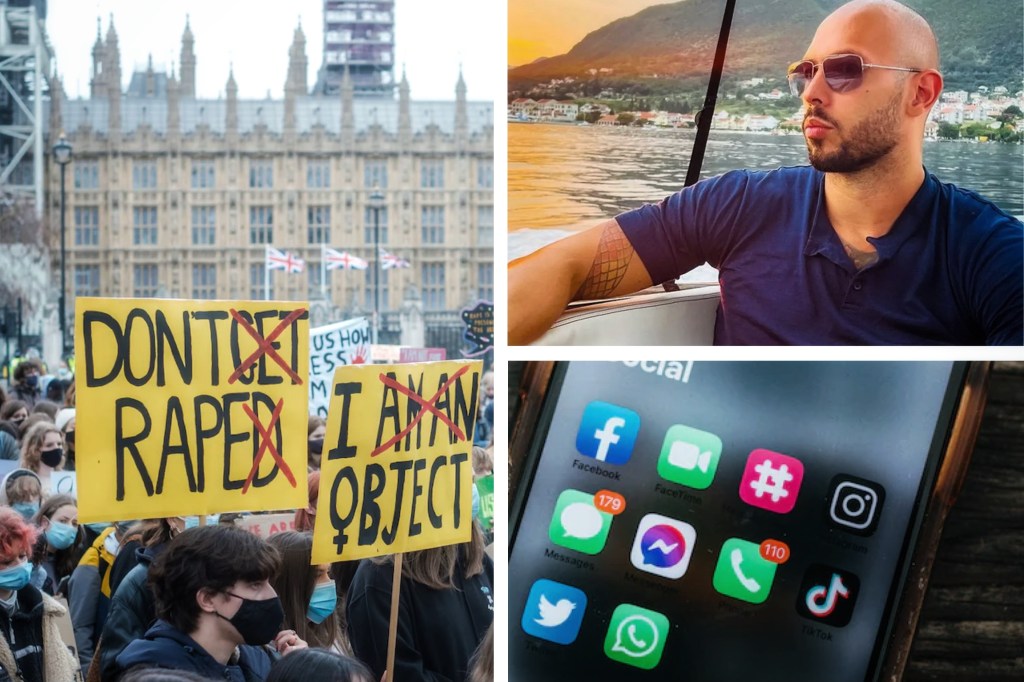
It feels like misogyny has become a common feature on social media in the last few years with the ‘memeification’ of Amber Heard’s rape testimony and the increase in the romanticisation of true crime in the form of Ted Bundy edits and fan pages for serial killers. This exploitation of victims and their stories has additionally found its way into mainstream entertainment, mostly notably The Gabby Petitio Story, Pam & Tommy and Golden Globe and Academy Award nominated Blonde. Despite the insensitivity of these ‘trends’ perhaps the most concerning part is that a worrying number of users of these apps have become desensitised to it. Online misogyny is so frequent that it is going unnoticed.
The rise of Andrew Tate
Incel forums have existed for decades, originally started as a way for ‘involuntarily celibate’ people to connect with others online. However, over recent years they have become a breeding ground for far-right extremism and have had real world impacts – most commonly in the UK linked to the Plymouth shooting in 2021. The violence found on forums that exist on sites like 4chan and Reddit is often downplayed but an investigation by the BBC in September 2022 found that there was a rape threat published every 29 minutes within the largest incel forums.
Whilst this extreme misogyny has always existed in the deep corners of the internet, it has recently made a public appearance in the shape of media personality Andrew Tate. Tate currently has over 5 million followers on Twitter and his videos on TikTok have reached over 12 billion views with topics discussed featuring misogynistic ideas that women are men’s property, rape victims should be ‘responsible’ for their attacks, and the recommendation that 18-year-old girls are the best to date as you can ‘make an imprint’ on them. Whilst these views would normally be found on hidden, controversial forums, Tate broke new ground appearing on TV shows and hanging out with politicians.
Despite Tate currently being detained in Romania on allegations of human trafficking and rape, his influence on young boys remains evident across the world. In the UK, there has been an increase in abuse faced by female teachers and students from pupils who have become fans of the ‘influencer’ alongside some schools taking action to re-educate some boys as young as 11 years old.
Overexposure to pornography
Whilst the ethics of pornography have long been debated, social media provides a much quicker, easier to access route that many young people are able to take advantage of. A recent study by the Children’s Commissioner for England found that the average age children first watch porn is 13, with 1 in 10 children viewing it by the time they are 9 years old. These shocking figures are also feeding into children’s and teenager’s views on relationships and sex with many seeing porn that depicts ‘coercive, degrading or pain-inducing sex acts’ by the age of 18 and 42% of teenagers believing that most girls enjoy acts of sexual aggression. Through the lack of regulation on sites such as Twitter and TikTok, children are being exposed to dangerous ideas about women and warped views of relationships.
Whilst the rise in new technology can create new opportunities in work and entertainment, it can also create new opportunities for online harassment to arise. AI technology has become a permanent feature of online spaces with art generators and computer made speeches making the rounds on platforms like Twitter and Instagram, but AI is also having an impact on websites like OnlyFans. Deepfake technology allows users to create non-consensual, edited explicit videos and photos of celebrities and even of people they may know. As well as it being easier for ordinary people to take advantage of others online, it can also be used as coercive control and blackmail in the form of ‘revenge porn’ despite the victim may not even knowing it exists.
‘Cyberflashing’ – the inevitable result of being a woman online
Actress and comedian Emily Atack recently made a documentary examining the cause of the overwhelming amounts of ‘dick pics’ and explicit messages she receives daily and whether she is subject to this because of the photos she posts of herself on Instagram. Although Atack had blamed herself, 76% of girls aged between 12-18 have been sent unsolicited explicit photos, predominately from older men they do not know. For many women, simply owning a social media account means they expect to be exposed to cyberflashing.
Co-founder of Reclaim These Streets, Jamie Klingler, told Atack that men send these explicit messages because they want to ‘silence and control’ women, that is it a product of wider patriarchal society. Through the impact that pornography has had on the ideas of sexual inequality in the minds of many men and the expectation that women then owe something in return for receiving these unsolicited photos, cyberflashing appears engrained within online society.
With the Online Safety Bill currently not mentioning women and girls, I spoke to Demi Babalola from the charity Glitch to find out what this means for online misogyny. Listen below to episode 8 of Beyond the Headlines to hear the interview.
 Politics Hour