
By Maisie Watson
March 9, 2023
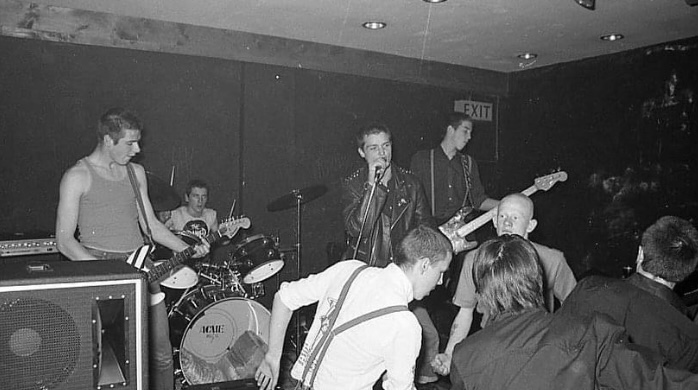
The Defects performing in The Harp Bar 1981
The Troubles
Punk in the 1970’s took England by surprise. This was, of course, to become an anti-Thatcher, anti-Government movement, and would erupt into a global phenomenon.
In Northern Ireland, people were preoccupied with more violent problems. Operating amongst the backdrop of a civil war, Punk threw its anchor down in the City of Belfast and began creating its own riot.
Bands such as The Defects and Ruefrex were amongst those spearheading the anti-sectarian movement. Unlike the English Punk movement, Belfast Punk provided an important bridge amongst the Catholic and Protestant communities.
Much of the politics of Northern Ireland was divided between the unionists and nationalists.
The underlying ideology of Unionism is a loyalty to the United Kingdom, along with a general Protestant background. Irish Nationalist favour a united Ireland and is founded on a Roman Catholic community.
Catholic communities in Northern Ireland complained of discrimination at the hands of Protestant forces such as the Royal Ulster Constabulary, the heavily militarised Northern Irish police force, comprising of a Protestant majority.
Catholic communities experienced discrimination in every aspect of life, and so, began to mobilise.
Violent attacks ensued, and the British Army were sent into Ireland to support the RUC’s efforts. Designed to separate the clashing communities, peace walls were erected across Belfast.
The Troubles in Northern Ireland began in 1969 and resulted in the deaths of more than 3,500 people.
“I have quite vivid memories of older kids putting up barricades at the end of the street … there were a lot of riots, a lot of people’s [houses] burnt out”, Paul Burgess, frontman of Ruefrex, tells me. Growing up in Shankill Road, Paul was no stranger to The Troubles conflict.
“You made your own fun, … running around making your own adventures as a kid. But then that fun changed to throwing stones at the army and at the police … even though it was probably inconsistent with the community I came from”
Paul Burgess, frontman of Ruefrex and author
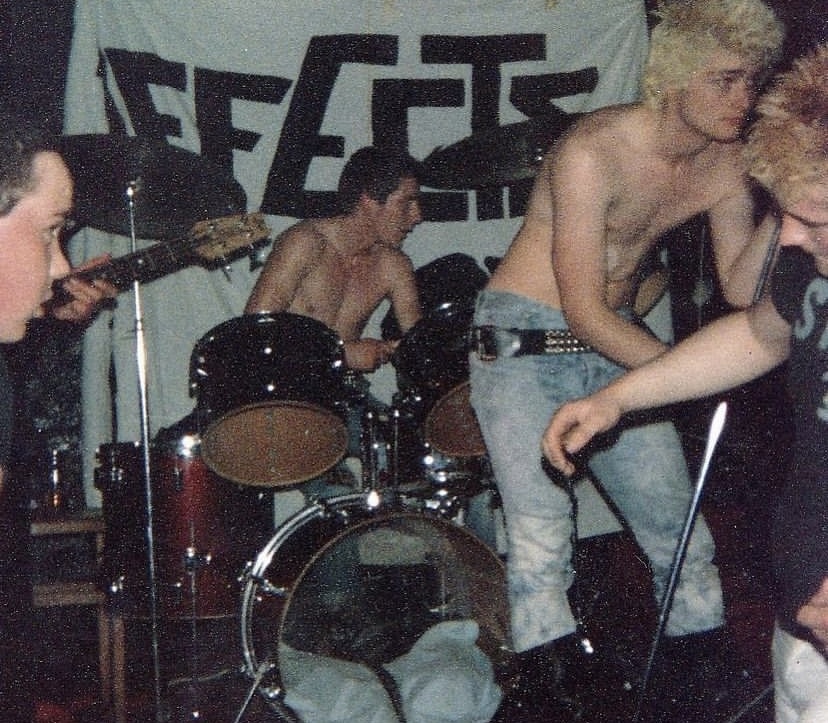
The Defects performing in The Pound 1981
With curfews set, killings increasing, and internment without trial, Northern Ireland was in a state of crisis.
Surrounded by barricades operated by the Army, who would stop and search you upon entry to the city, Belfast City Centre was desolate. The only people roaming the streets were the Punks.
Punk Defiance
“They were absolute dumps. But they let the punks in. They were always packed … everybody was going mental. It was a really good scene … We made a lot of friends, crossed the divide, it wouldn’t have happened if it wasn’t for the music”
Buck Murdoch, frontman of The Defects
As well as sitting down with Paul, I also spoke to Buck Murdoch, the frontman of Belfast band The Defects, and discussed with them their involvement in the punk scene.
Although both Paul and Buck agree that the punk scene crossed the divide, Paul emphasised placing caution on remembering the punk scene during The Troubles too idealistically.
“As we were finishing [the song], this guy pushed his way to the front of the crowd, lifted up his coat, and there was a gun … pushed down his trousers, and he said, ‘if you play one more f*cking note you’re getting shot”, Paul tells me, “and this was in the Harp, which was supposed to be this escapist place”.
Paul Burgess
Nevertheless, it was apparent that the culture of punk formed a bridge. It also served to riot against an otherwise uncontrollable situation. “It was 100% important for meeting people, from across the divide”, Buck tells me, mentioning how his songs resonated with the crowds who often found themselves in similar situations as the backdrop to The Defects song ‘Brutality’.
“Our drummer … got arrested for nothing, and they absolutely beat the c*ap out of him … when we saw him the next day, he was absolutely covered in blood … you can only write about what you know, we didn’t write love songs”.
It may seem impossible to picture yourself living in this dystopian reality, but for the people of Belfast, this was their reality for decades. For both Buck and Paul, writing songs in reaction to their lives served as an immensely important outlet, to keep themselves otherwise out of trouble.
Speaking about his new book Wild Colonial Boys: A Belfast Punk Story, Paul tells me how he found himself immersed into street gang culture. Ultimately, he found his way to the punk scene, and used it as an outlet to fight on issues such as integrated education.
The significance of the punk scene during The Troubles is undeniable. If anything, it allowed young punk-goers to simply get out of the house, at a time where many people feared even that.
If you want to hear more on punk and The Troubles, catch up on the interviews and reports mentioned in this piece from Beyond the Headlines on Spotify and Soundcloud at Liverpool Politics Hour.
 Politics Hour