
By Simi Ojla
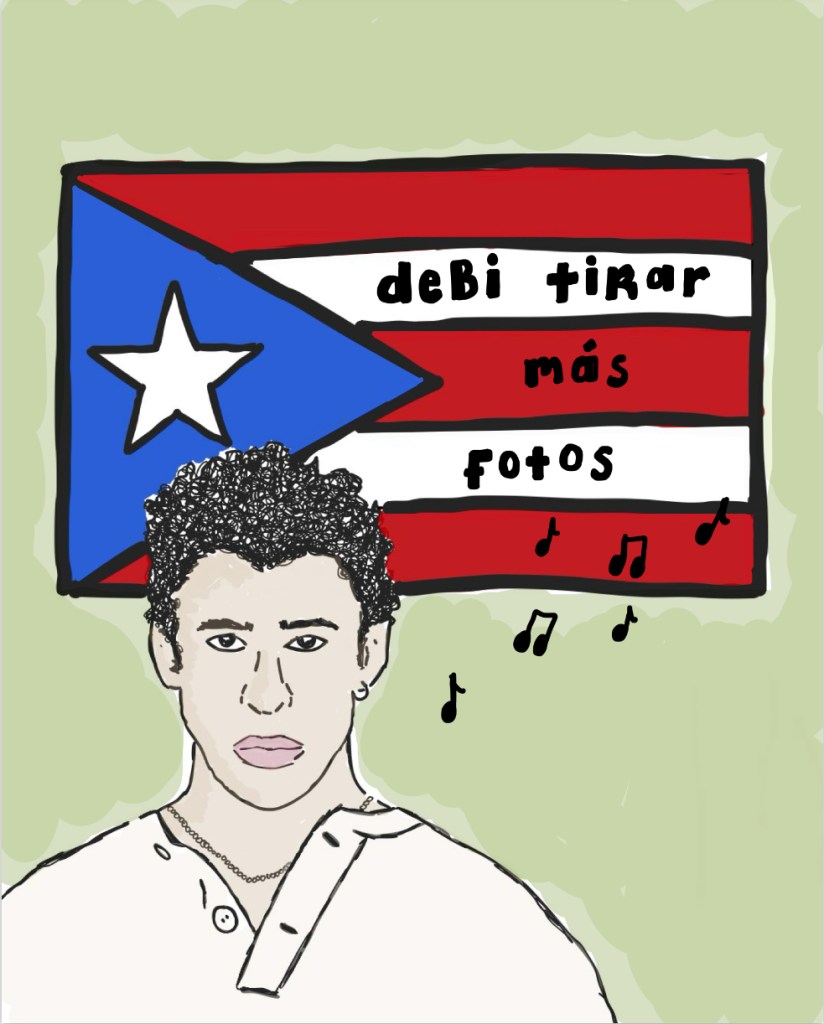
The release of Bad Bunny’s new album comes at a time when songs of protest are needed more than ever.
The 30 year old Puerto Rican rapper, otherwise known as Benito Antonio Martínez Ocasio, released his new album, Debi Tirar Mas Fotos on the 5th January and its been heralded his ‘love letter to Puerto Rico’. In this week’s episode of Politics in Motion, I broke down the relevance of his songs without being able to reference the songs themselves. As a result, I’ve decided to move over to the blog, for some deeper analysis of what this album means and how it ties music with politics.
Moving away from his usual music, laced with themes of heartbreak and centred around relationships, his new songs have much deeper layers of meaning. The blend of rich plena and salsa rhythms, coupled with his modern version of storytelling, reignite the best of traditional Puerto Rican music in an energetic and moving manner.
Despite being known for being outspoken about the social and political issues within the US-controlled island, the release of an entire album reveals a more personal and vulnerable element to his politics. Through his songs he has masterfully articulated both his love and concern for his home country.
Chronologically, the album begins with “Nuevayol!”, where he calls out to the Puerto Rican diasporas in New York. This is followed by his song “VOY A LLeVARTE PA PR”, meaning “I am going to take you to PR”, where the rest of the album remains. The album has gained significant popularity, and it is clear that the project has been a personal source of healing, as he said in a recent Time interview. “I found what my roots are: the sound that represents me.”
But what are those sounds saying?
Debi Tirar Mas Fotos, translated to, ‘I should have taken more photos’, refers to the historical culture of taking pictures that savour important moments in time. The meaning behind the song ‘DTMF’, an abbreviation of the album title, refers to the idea of regretting not savouring the beauty of something that once was.
“I should’ve taken more pictures when I had you
I should’ve given you more kisses and hugs whenever I could
I hope my people never move away”
The translation above emulates the core concept of the project: cherishing what is truly important before it’s gone. This applies to his family and friends but also to his country. In this sense, he sets the tone for the other songs in the album, and teases at the political statements surrounding the effects of US control on Puerto Rico.
This has picked up popularity, as fans have rushed to social media spaces like TikTok and Instagram to share their thoughts. Through this it is clear that the message of the album translates across many cultures, with users referring to the gentrification of their home countries and realising the slow eradication of their cultures.
Benito has utilised his power as one of the most powerful global artists to shed light on the political and social issues of his home country. He has used songs like “Turista” and “LO QUE LE PASÓ A HAWAii” to stress the harm that tourism and gentrification have done to the Island. This has been illustrated with the short film he put out in parallel with the album, which shows the detrimental impact gentrification has had in erasing the culture of his home.
“[Chorus]
Thеy want to take my river and my beach too
They want my neighborhood and grandma to leave
No, don’t let go of the flag nor forget the lelolai
‘Cause I don’t want them to do to you what happened to Hawaii”
Drawing parallels to Hawaii, Benito warns his people of a possible future where Puerto Rico becomes another US state. His music calls to them to protect their nationhood.
Since the aftermath of the Spanish-American war in 1898, the US government took control of Puerto Rico, marking it as a neocolony. Debi Tiras Mas Fotos exposes the truths of the political situation, hinting at neglect of locals in favour of US citizens coupled with gentrification.
All in all, the album is a searing representation of the rich and diverse history of Puerto Rico and also the unstable future for the country. Not only does it reinvigorate more traditional music, but it creates a new space for it in a modern context and shows that protest music is no longer facing extinction.
 Politics Hour