What Bad Bunny’s new album tells us about immigration, neocolonialism and gentrification in Puerto Rico

By Simi Ojla

The release of Bad Bunny’s new album comes at a time when songs of protest are needed more than ever.

The 30 year old Puerto Rican rapper, otherwise known as Benito Antonio Martínez Ocasio, released his new album, Debi Tirar Mas Fotos on the 5th January and its been heralded his ‘love letter to Puerto Rico’. In this week’s episode of Politics in Motion, I broke down the relevance of his songs without being able to reference the songs themselves. As a result, I’ve decided to move over to the blog, for some deeper analysis of what this album means and how it ties music with politics.

Moving away from his usual music, laced with themes of heartbreak and centred around relationships, his new songs have much deeper layers of meaning. The blend of rich plena and salsa rhythms, coupled with his modern version of storytelling, reignite the best of traditional Puerto Rican music in an energetic and moving manner.

Despite being known for being outspoken about the social and political issues within the US-controlled island, the release of an entire album reveals a more personal and vulnerable element to his politics. Through his songs he has masterfully articulated both his love and concern for his home country.

Chronologically, the album begins with “Nuevayol!”, where he calls out to the Puerto Rican diasporas in New York. This is followed by his song “VOY A LLeVARTE PA PR”, meaning “I am going to take you to PR”, where the rest of the album remains. The album has gained significant popularity, and it is clear that the project has been a personal source of healing, as he said in a recent Time interview. “I found what my roots are: the sound that represents me.”

But what are those sounds saying?

Debi Tirar Mas Fotos, translated to, ‘I should have taken more photos’, refers to the historical culture of taking pictures that savour important moments in time. The meaning behind the song ‘DTMF’, an abbreviation of the album title, refers to the idea of regretting not savouring the beauty of something that once was.

“I should’ve taken more pictures when I had you
I should’ve given you more kisses and hugs whenever I could
I hope my people never move away”

The translation above emulates the core concept of the project: cherishing what is truly important before it’s gone. This applies to his family and friends but also to his country. In this sense, he sets the tone for the other songs in the album, and teases at the political statements surrounding the effects of US control on Puerto Rico.

This has picked up popularity, as fans have rushed to social media spaces like TikTok and Instagram to share their thoughts. Through this it is clear that the message of the album translates across many cultures, with users referring to the gentrification of their home countries and realising the slow eradication of their cultures.

Benito has utilised his power as one of the most powerful global artists to shed light on the political and social issues of his home country. He has used songs like “Turista” and “LO QUE LE PASÓ A HAWAii” to stress the harm that tourism and gentrification have done to the Island. This has been illustrated with the short film he put out in parallel with the album, which shows the detrimental impact gentrification has had in erasing the culture of his home.

“[Chorus]
Thеy want to take my river and my beach too
They want my neighborhood and grandma to leave
No, don’t let go of the flag nor forget the lelolai
‘Cause I don’t want them to do to you what happened to Hawaii”

Drawing parallels to Hawaii, Benito warns his people of a possible future where Puerto Rico becomes another US state. His music calls to them to protect their nationhood.

Since the aftermath of the Spanish-American war in 1898, the US government took control of Puerto Rico, marking it as a neocolony. Debi Tiras Mas Fotos exposes the truths of the political situation, hinting at neglect of locals in favour of US citizens coupled with gentrification.

All in all, the album is a searing representation of the rich and diverse history of Puerto Rico and also the unstable future for the country. Not only does it reinvigorate more traditional music, but it creates a new space for it in a modern context and shows that protest music is no longer facing extinction.


Female sexual health: the good, the bad, the ugly.

By Simi Ojla

November 28, 2024

A conversation universal to women everywhere always starts with “I had a friend who tried [form of contraception], and she had a terrible experience”. Contraceptive horror stories circulate like exchanges made at a cash counter. Women trade stories, using one of the oldest forms of education to highlight one of the largest gendered issues affecting women today.

In one of our earlier episodes, I investigated this issue, focusing on two stories and three conversations. The link between gendered disparities in treatment within healthcare and University students’ experiences of contraception are key to this discussion. After engaging in conversations here at the University of Liverpool, it was clear that this was affecting students.

During my research, it was apparent that female sexual health was isolated from other gendered issues. Historically, contraception has been made a woman’s responsibility, meaning the progression of contraception has been slow and healthcare issues within this field amass. The effects of this neglect have manifested, targeting female students who are disregarded in conversations surrounding their own sexual health.

In the case of the first student I spoke to, it was just that. She was coerced, belittled and disrespected during her appointment in the Brownlow student health centre. After having consulted her GP at home, she decided it was in her best interest to remove her IUD. Despite the careful planning and research she had prepared, she was met with confusion over why she would want to replace “a Rolls Royce with a clapped out Old Ford”. Having been at the appointment with her, I can recall the blatant level of disrespect the female practitioner had presented, viewing my friend as someone who she could speak down to. Unfortunately, this is one example of a recurring pattern in which women are being diminished.

“Initially refused to do either a pregnancy test or an SDI test and I was only 19 at the time, but I used the phrase I think. Please stop pressuring me. The issue of SDI tests for me and my personal relationship is non existent. What if it was actually a real risk? You know how would they have been spoken to. Both pregnancy and STI tests came back negative but I was intensely pressured into doing them.

I did not want to do them in the slightest. I was just sobbing on you in the toilet because we were both just so taken aback that this happened to a student at a sexual health clinic as well. I then, after having been pressured and spoken down to and horrid comments made about me and I then had to, you know, get undressed and had a very invasive and vulnerable procedure done to me and there wasn’t a lot of bedside manner given in that respect. You know, it wasn’t, it was the way that my GP described it to me.

(Excerpt from an interview with first student)

There is a pattern that consistently shows how women are having bad experiences when discussing changes they want, that affect their own body. However, what is most disappointing is that this has occurred within the University sexual health clinic.

The second story reflects disparities within the wider NHS framework. I spoke to a student who told me her story, which was retold on the show using a voice actor.

The second student’s story retold.

Not only was this story uncomfortable and shocking to hear, it was even more disturbing to listen about the way the student’s pain was ignored. This case, like many others, signifies the gendered disparities between the ways physical pain is acknowledged among men and women. Women’s pain appears to be ignored or made to seem exaggerated, and this boils down to misogynistic stereotypes of the ‘overly emotional’ woman. The student’s statement exposes the issues regarding the lack of interest, awareness and education surrounding female sexual health.

Both these stories highlight the neglected nature of the area of female sexual health, symbolizing a much bigger network of stories that are told between many female friend groups.

This article is an adapted version of a special feature I did with the Politics in Motion team. You can find the episode here on Spotify.

Is this Britain’s Most Eccentric Pub Landlord?

By Harry Ashcroft

November 28, 2024

The cosy interior of the Politimore Arms, featuring a pint of the only draught drink they have, an Exeter Ale. Note also the candle on the left-hand side.

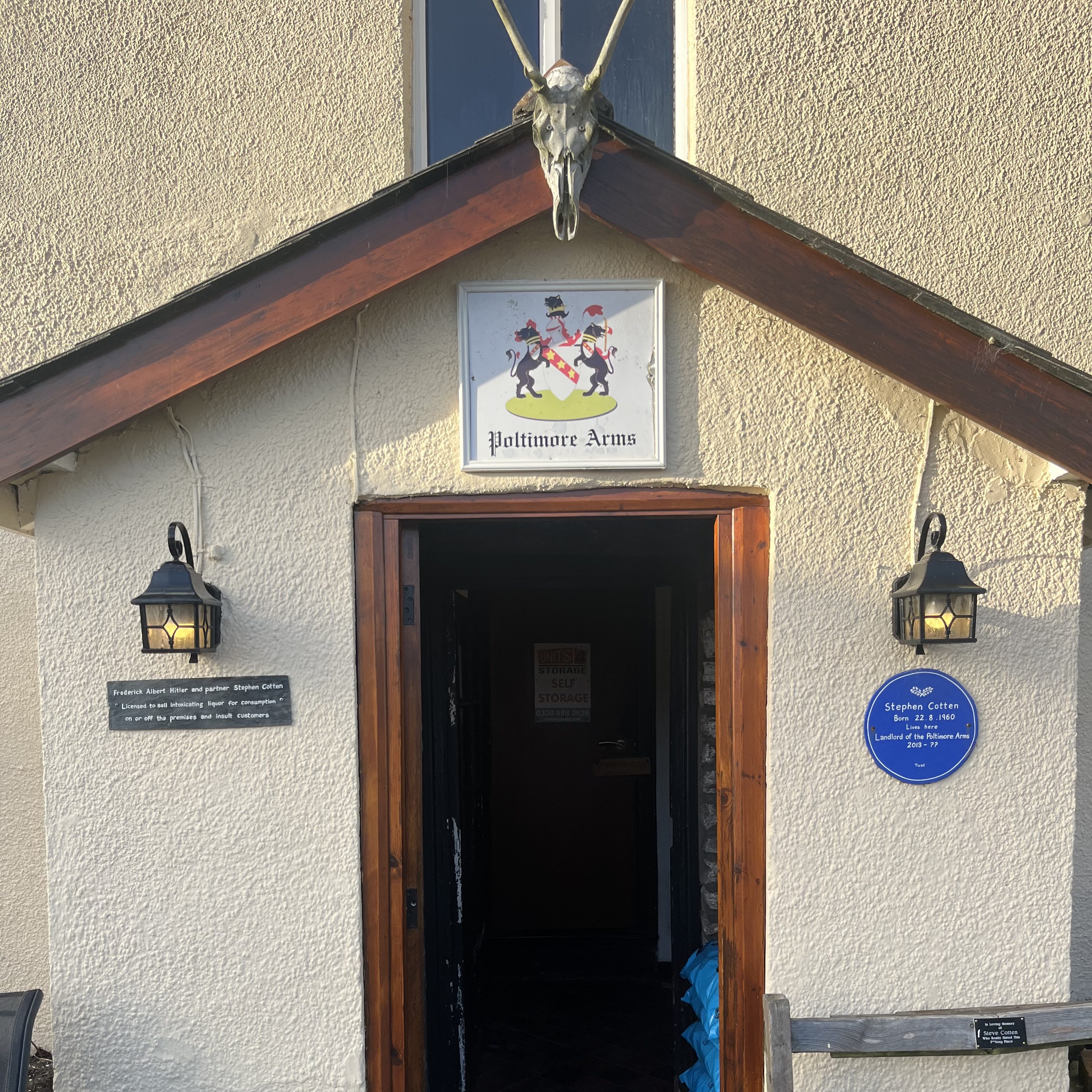
Last month I made the six-hour, England-splitting semi-circular drive from Liverpool down to North Devon to celebrate my Grandma’s 80th birthday. On the second afternoon there, as a group of us traversed the narrow country lanes, a glowing sight welcomed us in from the bleak and windy Exmoor hills. A humble and simple exterior that didn’t accurately show off the storied saga waiting for us inside.

“Whatever it takes, we don’t care. The pub is never going to shut.”

— Steve Cotten, Landlord of the Poltimore Arms

The humble yet inviting exterior of the pub. The sign on the left reads “Frederick Albert Hitler and partner Stephen Cotten. Licensed to sell intoxicating liquor for consumption on or off the premises and insult customers.” The late Fred Hitler was Steve’s old cat.

The Poltimore Arms is unlike any pub I’ve ever been in. Firmly cash only, completely off the grid and run by candles, solar panels and water from the spring up the hill. Its most notable aspect, however, is its landlord, who, much to my surprise, is already quite famous, as Britain’s Grumpiest Landlord.

Steve Cotten and his pub have been featured in major news outlets across Britain over the last few years. He is a man full of tales and anecdotes of the last decade of running the Poltimore Arms.

I asked if he would sit down and talk to me about how he runs the pub and what makes it so unique, as well as his political involvement as a parliamentary candidate for North Devon in the last two general elections. He was more than happy to oblige and the next day I returned, where before I had even begun conducting the interview he had begun working the audience of pub dwellers that consisted mainly of my extended family. Steve loves an audience.

The Interview

“My only business plan – Don’t do what the other pubs do because they’re all f***ing failing.”

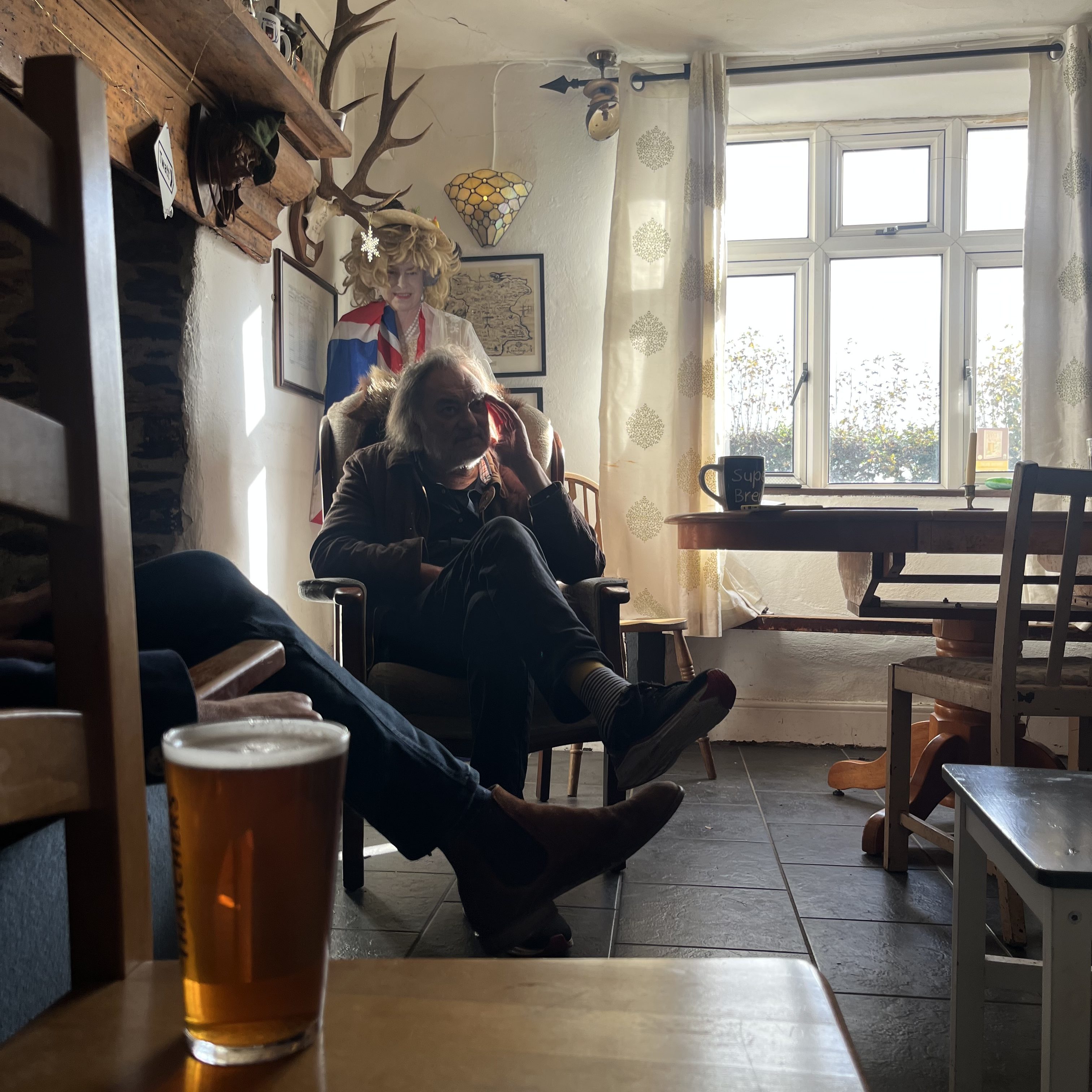
Steve in his chair surrounded by tea, tobacco and day drinkers.

Steve was invested in the interview. He informed me of his disappointment that I hadn’t brought a camera crew with me as he had “spent all morning” combing his hair. As it was only 2pm he was sat in his usual seat by the fire with a cup of tea. The rest of us in the pub had chosen to indulge in that day’s keg of Exeter Ale, self-poured so that we couldn’t “go on TripAdvisor and say the service was rude.” This created what I would call Steve’s “optimum storytelling atmosphere.”

We covered a lot of ground.

Steve explained how the pub is completely off-grid. The water comes from a spring two miles up the hill. When they run into water supply-related issues (a fairly often occurrence apparently), he puts a post on the pub’s Facebook page and the next day wakes up with five-gallon drums of water sitting outside, dropped off by local farmers. The electricity in the pub is supplied by newly set up solar panels.

“I don’t do food… Well, my barmaid cooks stuff on a Thursday night, but you wouldn’t want to eat that. I mean it really is diabolical.”

Steve explained how he had learnt to ride a horse to impress a woman who lived down the road, a Times art critic. This then led to the Poltimore Arms creating the countries only Pub Polo team. Despite being legally blind, Steve is apparently quite the polo player.

What really struck me, besides Steve’s constant jokes and his supposed parliamentary candidacy core policy of “free hair colouring on the National Health Service” for “the most oppressed minority in the world – ginger people,” was the true sense of community spirit that enveloped the foundations of the pub.

“It’s just p***heads basically, it’s all about the community working together.”

He explained how when elderly people in the community are sick or need help, the pub will ensure someone goes around to cut their grass or do their shopping. He says it’s all about looking after each other. To me, this is why the pub is so successful. Despite being in the middle of nowhere with not even a village connected to it, the sense of companionship is overwhelming. This is what makes places like this so vital in rural communities.

This article is an adapted version of a Politics in Motion radio special feature. You can listen to it, as well as my whole interview with Steve, on Spotify.

Why is the ‘godfather’ of AI warning us from its dangers?

Written By Yasmeen Alsayghe

Friday May 12th, 2023

What is AI?

Artificial intelligence (AI) is known to be “a system’s ability to correctly interpret external data, to learn from such data, and to use these learnings to achieve specific goals and tasks through flexible adaptation” (Kaplan and Haenlein, 2019). To use the analogy made by AI’s godfather Dr. Hinton, imagine 100,000 people whereby if one person learns something, the 99,999 others will automatically learn it too. This is known as a neural network, which is a system similar to the human brain in the way it learns and process information or even experience situations.

Although AI has been quite popular -especially chatbots- since its introduction, it has been quite controversial in the last few months.

Should we be concerned?

(Kevin Roose, NYT)

Kevin Roose (2023) -a New York Times journalist- decided to do an experiment on Bing chatbot by asking questions and deciding if the chatbot would demonstrate certain levels of rebellion. The results were shocking ranging from naming itself, sharing plans to takeover the world by shutting down systems, and even confess love to Roose. But fear not, Roose ensured that ‘so far’ Bing’s Chatbot still requires human input and orders to function while also highlighting the risks this technology holds. For more on Roose’s experiment, click here.

(Sky news, 2023)

As of May 2023, Geoffrey Hinton who is widely known as the godfather of AI quits his job at google along with showcasing regrets and warnings of how AI has developed to reach an extraordinary dangerous level endangering the human race. Dr. Hinton’s research paved the way for the introduction of the current chatbots such as ChatGPT. In an interview with the BBC, Dr. Hinton’ added that the latests developments of the AI chatbots were “quite scary”, while also ensuring that AI isn’t ‘currently’ as intelligent as human beings, but they they might be very soon. Dr. Hinton elaborated this idea by explaining that AI can be taught certain ideas by ‘bad actors’ such as “I need more power” -something that’s usually seen in dystopian Hollywood movies- to pursue their indoctrinated goals. Therefore, there has been demands to stop new developments of AI especially chatbots to invest in safety and control.

According to the CNN, tech leaders including Elon Musk, have called AI labs to pause any further AI developments and trainings by signing a letter, which was published after the introduction of ChatGPT version 4 by OpenI. They identified the growing risks AI has over humanity and urge to create a set of protocols for AI tools that guarantees the safety of an extraordinary growing technology.   Nevertheless, it should be noted that AI is extremely useful when not imagined in bad scenarios. Think of Siri, Alexa, and any other system that consistently helps you throughout your day. The latest ChatGPT version has a better ability to work with photos, to help you prepare a meal, or even what you need to draw pictures you upload. Additionally, it has made coders’ lives easier by being able to produce codes or even websites when asked. However, when it comes to students, how can ChatGPT help them in their academic lives without risking their academic integrity?

How is AI affecting students’ academic development?

ChatGPT has been popularized amongst students when it was first introduced, thinking that it would do a better job than students in writing their essays or assignments. Therefore, I did an experiment on ChatGPT where I asked it to write me a 1000 words essay on “Does the CNN effect still exists?”. Don’t worry, this essay question was already submitted and marked! But I used it specifically to know whether ChatGPT will provide me with the academic resources to support my arguments in the essay, while also being able to critically think and analyze the arguments.

Even though impressed by its ability to generate an essay, ChatGPT acted as a wikipedia page by introducing facts with no critical thinking or analysis throughout the essay which is what students are mainly marked for. Additionally, it was apparent that at some stage, ChatGPT introduced misinformation and invented inexistent resources. But that wasn’t enough for me to challenge ChatGPT abilities. Therefore, as an Arab, I used the exact question but wrote it in Arabic “هل لا يزال تاثير السي ان ان موجود؟”. ChatGPT showed extreme weakness when the orders became in Arabic, which indicate ChatGPT’s inability to work with different languages at the same level of analysis it has with English. This is particularly interesting as the neural network is supposed to circulate knowledge across its network but the language barrier is strong within AI that it has led to inability to generate the required response.

To learn more about my experiments with AI, listen here.

Local Elections May 2023: A Comprehensive Roundup

By Daniel Tagg

Following on from my conversation with former leader of the Liverpool Lib Dems turned university lecturer Paula Keaveney on yesterday’s show, it’s time to take a look at how some of the hottest talking points from this year’s local elections panned out. From Tory-free Liverpool, to a Labour resurgence, here’s what we know now that all of the votes have been counted…

Liverpool City Region

Much of my discourse with Paula centred around the unique set of circumstances that surrounded these local elections within Liverpool. Following the now infamous corruption scandal involving many previous members of the council, all positions were up for re-election, with boundary changes and a reduction in the number of wards only added to the complications – but would this turbulent context lead to some shocking results? In short, no. As expected, Labour dominated the area once again, winning 61 of the 85 seats. The Lib Dems (15 seats) and the Green Party (3 seats) also enjoyed modest success, while the Tories (0 seats) managed to outdo themselves with their lowest vote share ever in Liverpool. It is also worth noting that, as Paula predicted, there was no success for any of the poorly organised (unofficial) Liberate Liverpool candidates, despite their recent campaigning surge.

The National Picture

As far as the country as a whole is concerned, the overriding story is that it has been a horror show for the Conservatives. When we went on air on Friday, Paula and I discussed how the first batch of results painted a worrying picture for the Tories, with Paula affirming that she predicted that it would only get worse as the day went on – and she was absolutely right. Following significant damage in Medway and Middlesborough in the morning, the afternoon saw the Conservatives suffer considerable losses to Labour in Stoke and Plymouth, and lose control of the historically safe seats of Stratford-upon-Avon and Windsor to the Lib Dems. Overall, the Conservatives lost just under 1000 seats nationwide, with Labour and the Lib Dems gaining over 1000 between them. Whilst these elections cannot be counted on as accurate forecasts for the next general election, they do point towards a wholesale rejection of Rishi Sunak’s party in favour of Red and Orange brands of centrism.

University Of Liverpool Candidates

One thing that I’m sure all of my fellow University Of  Liverpool politics students will have had their eye on is how some of their very own lecturers fared in the polls. However, the fact that they were standing for the Conservative party in overwhelmingly Labour areas left them little hope. As was firmly predicted by Paula, none of the three were elected; coming out on top of the trio was Danny Bowman with 71 votes in Calderstones, closely followed by Andrew Roe-Crines with 68 in Anfield, with David Jeffery bringing up the rear with 39 in Aigburth. I have no doubt that these were the kind of results they expected, but kudos to them for standing anyway.

Summary

All things considered then, things turned out pretty much as was anticipated: Liverpool remains a Tory-free zone, Labour and the Lib Dems pick up the pieces from the inevitable Conservative collapse on the national level, and UOL’s three Conservative candidates fail to break triple digits in safe Labour seats. Now we just have to wait and see if the Tories can recover in time for the general election in 2025, or whether Keir Starmer and Ed Davey can continue to capitalise on the long-awaited Conservative disillusionment within Britain!

If you missed this week’s episode then fear not! You can catch up with Beyond The Headlines on Spotify to hear Paula Keaveney and I discuss at length her own career in politics, and whether or not she would recommend that any young politics student tries their hand at local council. Want to know her verdict? Better get listening! Enjoy!

Punk and The Troubles: How Punk Created it’s Own Riot

By Maisie Watson

March 9, 2023

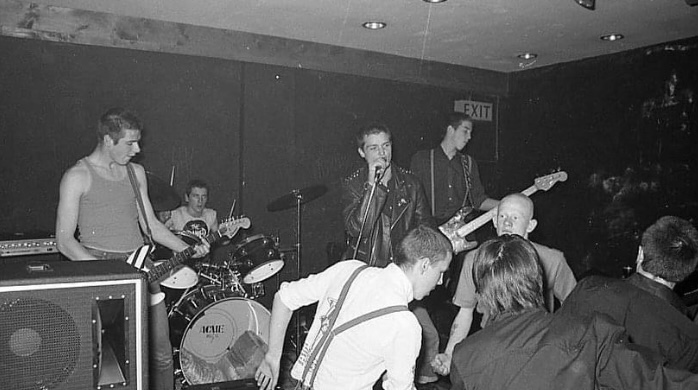
The Defects performing in The Harp Bar 1981

The Troubles

Punk in the 1970’s took England by surprise. This was, of course, to become an anti-Thatcher, anti-Government movement, and would erupt into a global phenomenon.

In Northern Ireland, people were preoccupied with more violent problems. Operating amongst the backdrop of a civil war, Punk threw its anchor down in the City of Belfast and began creating its own riot.

Bands such as The Defects and Ruefrex were amongst those spearheading the anti-sectarian movement. Unlike the English Punk movement, Belfast Punk provided an important bridge amongst the Catholic and Protestant communities.

Much of the politics of Northern Ireland was divided between the unionists and nationalists.

The underlying ideology of Unionism is a loyalty to the United Kingdom, along with a general Protestant background. Irish Nationalist favour a united Ireland and is founded on a Roman Catholic community.

Catholic communities in Northern Ireland complained of discrimination at the hands of Protestant forces such as the Royal Ulster Constabulary, the heavily militarised Northern Irish police force, comprising of a Protestant majority.

Catholic communities experienced discrimination in every aspect of life, and so, began to mobilise.

Violent attacks ensued, and the British Army were sent into Ireland to support the RUC’s efforts. Designed to separate the clashing communities, peace walls were erected across Belfast.

The Troubles in Northern Ireland began in 1969 and resulted in the deaths of more than 3,500 people.

“I have quite vivid memories of older kids putting up barricades at the end of the street … there were a lot of riots, a lot of people’s [houses] burnt out”, Paul Burgess, frontman of Ruefrex, tells me. Growing up in Shankill Road, Paul was no stranger to The Troubles conflict.

“You made your own fun, … running around making your own adventures as a kid. But then that fun changed to throwing stones at the army and at the police … even though it was probably inconsistent with the community I came from”

Paul Burgess, frontman of Ruefrex and author

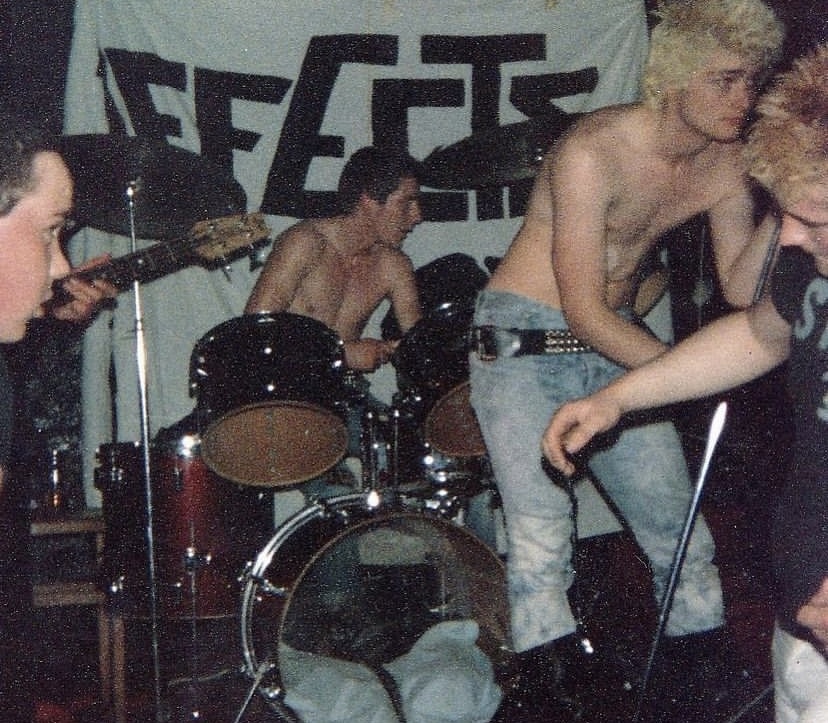
The Defects performing in The Pound 1981

With curfews set, killings increasing, and internment without trial, Northern Ireland was in a state of crisis.

Surrounded by barricades operated by the Army, who would stop and search you upon entry to the city, Belfast City Centre was desolate. The only people roaming the streets were the Punks.

Punk Defiance

“They were absolute dumps. But they let the punks in. They were always packed … everybody was going mental. It was a really good scene … We made a lot of friends, crossed the divide, it wouldn’t have happened if it wasn’t for the music”

Buck Murdoch, frontman of The Defects

As well as sitting down with Paul, I also spoke to Buck Murdoch, the frontman of Belfast band The Defects, and discussed with them their involvement in the punk scene.

Although both Paul and Buck agree that the punk scene crossed the divide, Paul emphasised placing caution on remembering the punk scene during The Troubles too idealistically.

“As we were finishing [the song], this guy pushed his way to the front of the crowd, lifted up his coat, and there was a gun … pushed down his trousers, and he said, ‘if you play one more f*cking note you’re getting shot”, Paul tells me, “and this was in the Harp, which was supposed to be this escapist place”.

Paul Burgess

Nevertheless, it was apparent that the culture of punk formed a bridge. It also served to riot against an otherwise uncontrollable situation. “It was 100% important for meeting people, from across the divide”, Buck tells me, mentioning how his songs resonated with the crowds who often found themselves in similar situations as the backdrop to The Defects song ‘Brutality’.

“Our drummer … got arrested for nothing, and they absolutely beat the c*ap out of him … when we saw him the next day, he was absolutely covered in blood … you can only write about what you know, we didn’t write love songs”.

It may seem impossible to picture yourself living in this dystopian reality, but for the people of Belfast, this was their reality for decades. For both Buck and Paul, writing songs in reaction to their lives served as an immensely important outlet, to keep themselves otherwise out of trouble.

Speaking about his new book Wild Colonial Boys: A Belfast Punk Story, Paul tells me how he found himself immersed into street gang culture. Ultimately, he found his way to the punk scene, and used it as an outlet to fight on issues such as integrated education.

The significance of the punk scene during The Troubles is undeniable. If anything, it allowed young punk-goers to simply get out of the house, at a time where many people feared even that.

If you want to hear more on punk and The Troubles, catch up on the interviews and reports mentioned in this piece from Beyond the Headlines on Spotify and Soundcloud at Liverpool Politics Hour.

A Look into Carbon Capture: Solution or Danger?

By Lily Bird

As we are all aware, the climate crisis is an ongoing issue of the utmost importance. With rising global temperatures, sea levels and extreme weather events, the impacts of climate change are already being felt across the globe.

A possible solution to the ongoing climate crisis is carbon capture. Carbon capture has been a topic of controversy among both scientists and policymakers, with proponents touting it as a promising solution, while critics argue that it is only a temporary solution which does not address the cause of the issue. Recently, on Beyond the Headlines, I investigated how young people are affected by the ongoing issue of the climate and found that some feel a sense of betrayal at the lack of government initiative to get the grips with the crisis and are plagued by a sense of anxiety for the future.

Could carbon capture be a key tool in the fight against climate change and put our minds at rest? To find out more I met with Professor in Geology and Earth Science here at the University of Liverpool to discuss with him whether carbon capture is a feasible solution to the climate crisis.

What is Carbon Capture?

Carbon capture works by capturing carbon dioxide emissions from industrial processes and storing or reusing the carbon in different industrial processes. Professor Daniel pointed out that due to the many industries which rely on carbon, a good use of carbon capture would be to put it back into these manufacturing processes, such as the steel industry. Those in support of carbon capture also argue that it can be used in conjunction with renewable energy sources to cut down carbon emissions.

Daniel also discussed how there is a fear that carbon capture may give the green light to oil and gas companies to keep pursuing fossil fuels and is only a superficial fix to a serious and complex issue. This is especially relevant following Rishi Sunak’s poor commitment to tackling the climate crisis. Sunak has ignored climate experts and gone ahead with investing in oil and gas, meaning that the global target to keep the temperature rising below 1.5 degrees Celsius is nearing impossible.

There are also fears about the potential dangers of carbon capture. Critics have argued that these technologies are in their early stages and that storing carbon underground could potentially be dangerous. I discussed this with Daniel who was reassuring in his response that contrary to some sensationalised media, these technologies are not so new to create concerns about safety and accidents such as leaks are unlikely. However, Daniel cited the main concern regarding carbon capture is its tremendous cost which would be difficult to fund. Again, this is not promising with the current government’s lack of commitment to investing in a green economy. The government’s Latest Energy Plan, which was outlined by Rishi Sunak over a month ago, essentially defied the advice of climate scientists and went ahead with new oil and gas developments. The policies outlined in the plan have the potential to worsen the already critical climate crisis that we face. Sunak’s track record on green policies during his time in the Treasury was disappointing, and his position as prime minister only seems to be taking the UK further away from the urgent need for decarbonization.

Overall, issues surrounding carbon capture are complex. However, it is important to bear in mind that although it could be a key step, it is by no means the answer to solving the climate crisis. As something of a climate doomer myself, I was both relieved and disappointed by my interview with Daniel. Yet, it is clear we must not rely on carbon capture and continue to strive towards a greener future using sustainable energy sources.

To find out more, listen to the full interview with Daneil on Beyond the Headlines. Link here.

All about endometriosis: the silent condition affecting millions of women

By Emily Smith

Endometriosis might just be the most widespread medical condition you’ve never heard of. One in ten women in the UK have endometriosis, and yet it takes an average of eight years for a diagnosis to made. Doctors are often dismissive or ill-informed, perpetuating the harmful stigmas that already exist around women’s health.

Image available via Pixabay

Endometriosis is a chronic condition where tissue similar to the lining of the womb is found elsewhere in the body. This tissue breaks down every month, causing chronic pain and discomfort. Endometriosis can also cause heavy periods, pain during sex and infertility.

Following on from our discussion on the Lunch Bunch with Ffion Brighton on endometriosis, I wanted to share my experiences living with the condition and explore why this is a condition that so often flies under the radar.

I was seventeen when I finally went to my GP to complain about my period pain for the first time. For as long as I can remember, I have experienced chronic period pain every month, often causing me to miss school. Myself and those around me brushed off this constant pain, saying it as normal, and something that happened to every woman. I convinced myself that I was just unlucky with the periods I was getting. I don’t blame those around me for this messaging; the misinformation surrounding women’s reproductive health infiltrates everybody, myself included. I can’t remember what finally prompted me to go to the doctors, but as soon as I did I was told I had suspected endometriosis and put straight on the contraceptive pill in an attempt to mask my symptoms. No further questions, no further tests.

Endometriosis is difficult to diagnose and impossible to cure. Anybody living with this disease knows this all too well. These two factors combined often discourages women from advocating for a formal diagnosis of the disease from their doctors, myself included. If there is no cure, then what’s the point in being diagnosed, if not for a few words on a piece of paper? At least that’s what I thought.

The truth is that diagnosis can be empowering for people living with a chronic condition. Being able to definitively know that what you’re suffering with even exists is an invaluable part of someone’s journey through a chronic condition. Diagnosis can be bittersweet, offer clarity and help bring about change and treatment. But with an average wait of eight years before diagnosis, it’s perhaps no wonder why women are reluctant to seek help from their doctors. Diagnosis is also invasive, with a laparoscopy being the only way to formally determine endometriosis.

Image available via Pixabay

Treatment options are not much better. My experience of being put straight on the pill at such a young age is congenial with many other women’s experiences. There is still very little research done into the long term side effects of the pill, especially psychological ones. This is the case with most medical research done on women’s reproductive health. To put this into context, there is 5 times more research into erectile dysfunction which only affects 19 per cent of men, than in premenstrual syndrome, which affects 90 per cent of women.

Just last month, the i reported the stories of two women who were put on the contraceptive pill at a young age for painful periods, which masked their symptoms and lead to a missed diagnosis of endometriosis. Not only is the condition getting worse during this time, but it also has a harmful effect on the mental health of women who feel their symptoms are being dismissed. Doctors advising young women presenting with symptoms of endometriosis to go on the pill without any further investigations of questions (as in my experience) can be dangerous and detrimental to a woman’s physical and mental health. This can force women to choose between being in constant physical pain, or mental distress.

So what can we do? There is already a societal stigma that discourages anybody from speaking about their reproductive health. But it is these conversations that are so important in putting endometriosis and women’s sexual health on the public and medical agenda. Speaking about reproductive health and championing the voices that are is the first step. Be a part of the solution and take a listen to our episode to learn more about endometriosis and its impact. You’ll hear from Ffion Brighton and Millie, who suffers from endometriosis and tells her story about her experiences with the disease.

For more discussions on important conversations, you can catch up with every episode of the Lunch Bunch on Spotify and Soundcloud.

Finland Joins NATO – Why is this significant? Who’s Next?

By Andy Spence – May 3rd, 2023

On 4th April 2023 Finland became the 31st member of the North Atlantic Treaty Organisation (NATO). This is a move that has been expected ever since the Russian invasion of Ukraine in February 2022.

Russia and Finland: A complex relationship

Russia and Finland have a long and complex relationship which spans centuries of empire and war. Finland was a part of the Russian Empire until it gained independence in 1917 following the Russian Revolution. During the Second World War, Finland was against the USSR and backed NAZI Germany in an effort to maintain their political independence from Russia.

NATO/Russia Buffer Zone – A thing of the past?

After the Second World War Finland was to remain neutral and make up part of a ‘buffer zone’ between the East and West. This buffer zone has now been almost entirely dismantled. Even prior to Finland’s enterence into NATO, the Baltic States of Estonia, Latvia and Lithuania joined NATO in 2004 which became the first time NATO and Russian land had touched. The direct border between NATO and Russian territory has doubled with the admission of Finland into the Alliance.

NATOs expansion eastward is what Russia claims triggered the invasion of Ukraine in 2022 as Russia were supposedly seeking to prevent Ukraine from falling into NATO. However, Putin’s plan to prevent NATO’s expansion has only furthered and accelerated it by panicking other countries which neighbour Russia. It is unlikely that Finland will be the last in the region to join the Alliance. Sweden are currently in the process of joining NATO and it has been announced that Ukraine will join the Alliance when suitable.

Whenever there is talk of NATO expansion into Eastern Europe or Scandinavia, Russia accuses NATO of acting aggressively. These are claims which have been adamently rejected by NATO.

“NATO is a defensive alliance, NATO and Finland have never been, and will never be, a threat to Russia. It is Russia that has invaded neighbours.”

Jens Stoltenberg – NATO Secretary General

Ukraine in NATO?

With NATO reaching the Russian border up at the Baltic Sea, it is worth taking a look further south at Ukraine. Ukraine joining NATO would be a catastrophe for Russia who seek to turn Ukraine into a Russian puppet state like Belarus. In fact, the Russian invasion of Ukraine was largely to prevent Ukraine from joining the Alliance at all. However, it appears that the invasion may have backfired in that regard. In a surprise visit to Ukraine in April, Secretary General Stoltenberg reassured Ukrainian President Volodymyr Zelenskyy that Ukraine will be welcomed into NATO.

“Ukraine’s rightful place is in NATO and over time our support will help you make this possible.”

Jens Stoltenberg – NATO Secretary General

However, Ukraine will not be able to join NATO whilst at war with Russia. Article 5 of the Washington Treaty which pertains to the collective defence aspect of the Alliance would instantly to triggered by any Russian attack therefore leading to a full NATO vs Russia war. Therefore it will be untenable for Ukraine to join NATO until the war is concluded.

Is Sweden Next?

Sweden and Finland applied to join NATO together in 2022, so why has only Finland joined?

Before a state can join NATO, all pre-existing NATO members are required to approve the application. Sweden’s application has been halted by two NATO members, Hungary and Turkey. The main issue is with Turkey who accuse Sweden of supporting, what Turkey deems to be, Kurdish terrorist groups. This raises questions of whether domestic issues should be used to hinder international affairs which are unrelated to the domestic issues in question.

Despite the hold up caused by Hungary and Turkey, Stoltenberg remains confident that Sweden will soon become the 32rd NATO member.

“I’m confident that Sweden will become a member not least because all NATO allies, also Turkey, invited Sweden to become a member.”

Jens Stoltenberg – NATO Secretary General

Therefore, it seems as if the expansion of NATO will not stop at 31 member states and that Sweden will imminently join. Likewise, Ukraine will join once the Russo-Ukraine war comes to an end.

This topic was discussed on the most recent episode of the Lunch Bunch, stream here on Spotify!

TikTok: Is it time to clock out of the app?

14th March 2022

Written by Ffion Brighton

Sometimes all you can be bothered to do is stare at your tiny screen and scroll for hours on end. When you have an app that gives you a constant stream of indulgent content, why would you spend your time on anything else?

For the past 4 years, TikTok has become a staple form of social media for young people. It’s seen as such an attractive pastime that many people feel themselves constantly reaching for their phones instead of dealing with the effort of day-to-day tasks.

“TikTok makes me procrastinate a lot. I’ll postpone things I need to do and take way longer breaks as I think I’ll be on the app for only a few minutes, but I’ve actually been on it for half an hour.”

Ebony, Liverpool

What makes this app so addictive? Does constantly consuming quick-paced content decrease young people’s attention span? What can be done to break the habit of relying on your phone for entertainment? These questions were answered in a recent interview with the wonderful Professor Peter Kinderman, a clinical psychologist and professor at the University of Liverpool.

So, what makes this app so addictive?

“I’d say TikTok has shortened my attention span to some degree. It feels like nowadays if something doesn’t draw attention within like ten seconds, then you think ‘oh never mind’ and move on”

Richie, Liverpool

Professor Kinderman explained how the app is designed for you to be a consumer, and the payment is your attention. The algorithm is created to maintain your attention by feeding you catered content, making you want to scroll constantly. In his words, it’s like going to Morrisons and seeing a 2-for-1 offer on a packet of crisps. You may have gone to the shop intending to buy only the necessities, but now your attention is drawn to the deal. Ultimately, you feel compelled to consume something you crave rather than what you actually need.

This is just like what TikTok does. Maybe you went on your phone to reply to a message from your mate, but now you find yourself on the app, scrolling for hours because you’re getting more entertainment than you bargained for.

Is TikTok decreasing our attention spans?

When asking the public about their experience with the app, the majority felt they used it as a mode of procrastination

“It really does affect my productivity and getting out of bed, things like that. I could stay glued to the screen for hours and hours and hours.”

Brooke, Northern Ireland

Personally, I can relate to this. When a massive assignment is due, sometimes it can be so overwhelming that I feel drawn to the app instead of working on the important task. It made me wonder: Is the app actively decreasing our attention spans?

Professor Kinderman doesn’t think that’s the case. For generations, young people have been known for finding it difficult to pay attention for long periods of time. It is not a matter of our attention spans decreasing, but rather that we now have an app that is formatted to be attractive to those with low attention spans.

The prefrontal cortex doesn’t fully develop until the age of 25. This area of the brain assists us in self-discipline, impulse control, and postponing immediate gratification. This means that anyone under 25 will typically be drawn to TikTok and struggle to put their phone down.

Kinderman doesn’t think it’s the fault of the user, but rather the developer of the app. It is designed to keep your attention, and with young people’s prefrontal cortex not being fully developed, it is difficult to resist the urge to stop scrolling. Those who created the app know this and make money on the fact that they can hold your attention for hours on end.

In what ways can you stop becoming addicted to the app?

Kinderman suggests finding a process that works for you. He found that having his desk facing the window gave him enough distraction to actually focus on the work at hand. Crucially, you want to make the decision; only you have the control to want to make a change.

Deciding to better your life is a conscious choice, and thus with TikTok, it entails setting limits on ourselves. A great way to do this is to have timers on the app to limit your usage. It is also important to have a conversation with yourself about whether you are going on the app for actual enjoyment, or rather to distract yourself from the things in life that you are avoiding.

The Round-Up

Ultimately, TikTok has the potential to be addictive. It takes advantage of the fact that its users want the content they like on a continuous scroll. Its ‘For You’ page is literally designed just FOR YOU! However, listening and speaking to Prof Kinderman has made me more aware of the fact that it doesn’t have to be an app you can’t detach yourself from. And it goes without saying, the app has some terrific features. It is incredible for introducing people to new information and connecting them with others across the globe.

But, if you find yourself glued to the app, I think we both know it may be time to clock out.

Want to find out more? Head over to the Liverpool Politics Hour on Spotify, where you can listen to my interview with Peter Kinderman and get a greater insight into what makes TikTok so addictive to young people.