‘I like to beautify the ugly and uglify the beautiful’: Returning to interview Sophie McQue, a Gen Z poet

Written by Tanzi Stewart-Stewart

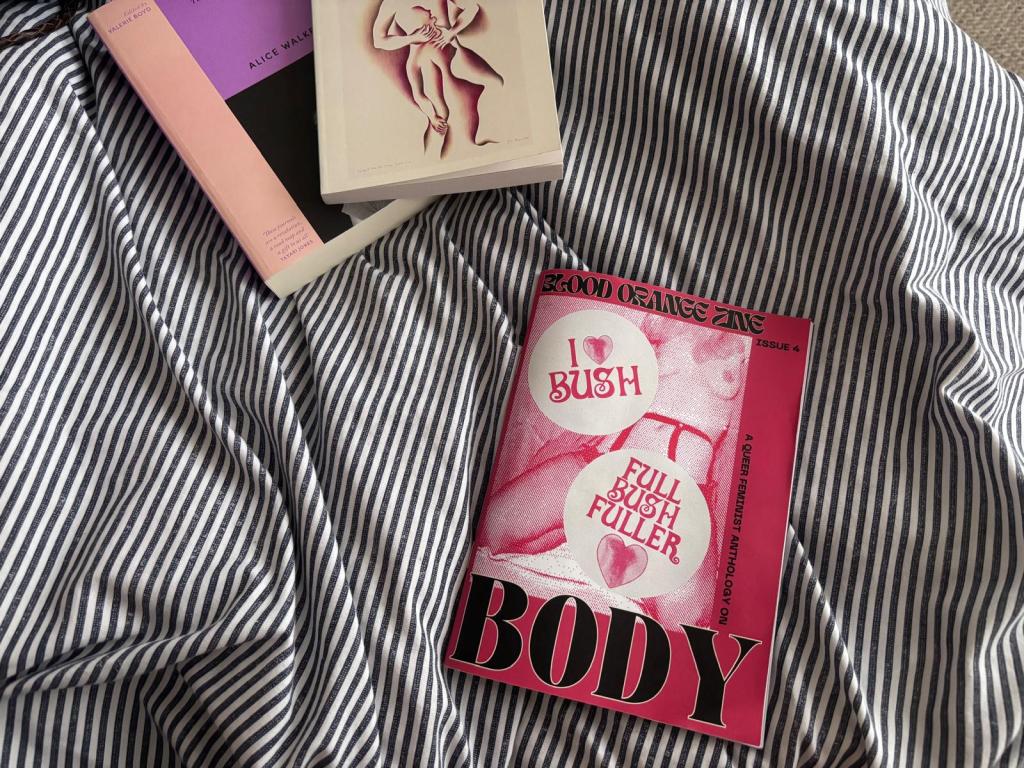
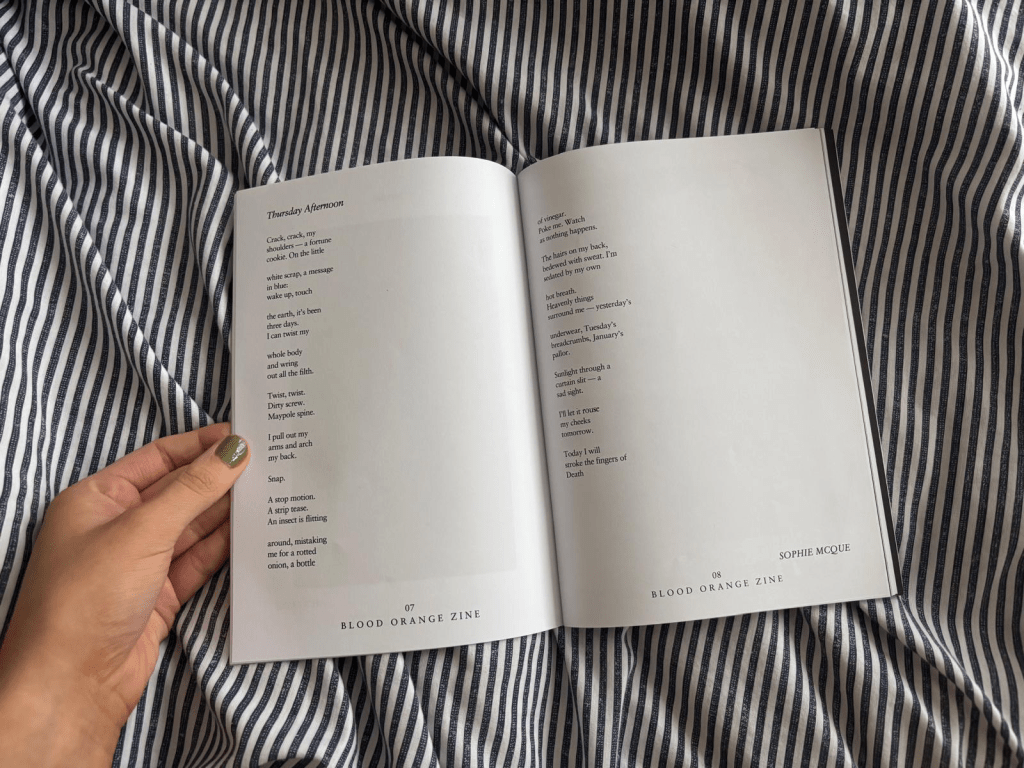
Loyal listeners may remember Sophie McQue from her interview about her and her friend Rosie’s feminist book club, Tongues of Stone. But a book club is dedicated to other authors, and Sophie herself has recently been published in a feminist zine, Blood Orange Zine, based here in Liverpool. 

Sitting in Sophie’s bedroom now, it is every inch a bohemian muse’s boudoir draped in white lace and adorned with biblical iconography. Even my interviewee herself is decorated similarly, with a stick and poke of the virgin mary on one arm and ropes of pearls and crosses cascading over her other shoulder. She is an atheist, of course.

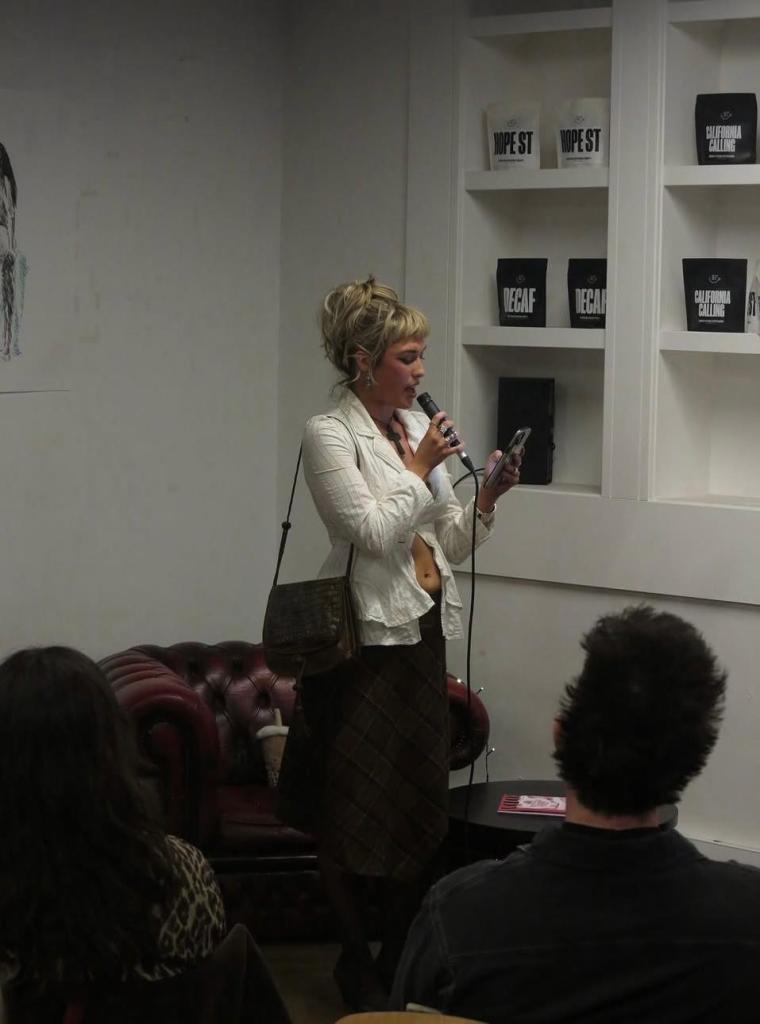
I previously interviewed Sophie on The Young Ones on the topic of young women in literature in Liverpool. On that note, Blood Orange is a queer feminist zine, with themes such as female rage, female friendships, and reclaiming the night. Their most recent publication was on the theme of Body, and both Sophie’s first publication and public poetry reading. I enjoyed my first interview with Sophie so much, and am so interested in the topic myself, that I wanted to revisit her on the occasion of her first publication. 
How did you approach the body brief?

‘I already had poems written. I had actually submitted to their female friendships theme but they didn’t publish it. But this next theme, body, I always write from the body about the body, and they published it. I always use themes of the grotesque…’

Is the female body inherently political to you?

“Yeah. Yes of course… Females have always been kind of looked at through their body and been put at a disadvantage for that. However, I don’t tend to always explore that in my writing. I explore the grotesque. Because I think women’s bodies are often expected to be held up as clean and sexy in a lot of media and I like to confront the abject and the grotesque in my writing. I like to beautify the ugly and uglify the beautiful. I confront the grotesqueness of my body while using very feminine and floral language. I use a lot of animal imagery, feminine colours, and stuff. Delicate things that represent femininity – it makes it a bit creepier I think, approaching the abject from a hyper-feminine angle.”

What was the reading like?

Well.. I mean I was terrified! And they forgot about me. There was a woman there, the creator of the magazine’s old tutor, and she went up and reminded her, so I was the closing act which was daunting for my first ever reading.. However by the end of it I was a little bit tipsy so that helped! I felt empowered- I got a nice cheer from all my friends, and I felt proud of my writing. I just had a feeling that it would be something people resonated with. It gave me confidence knowing that I could read my work with a northern accent. I speak a little bit drab. All my vowels are quite… What’s the word… flat?

(Sophie is from the North-East, with a Mackem accent.)

Final Question… What’s your favourite line from your poem?

Oooh! Dirty screw. May pole spine
For a deeper discussion on women in literature, I encourage you to revisit our broadcast on young women in literature where I originally interviewed Sophie on her book club, available below (Interview begins at 27:58).

You can find Sophie’s work on @dreamboatsophie on instagram and her book club at @tonguesofstone. You can find Blood Orange Zine and their upcoming summer zine at https://bloodorangezine.com/

Haysam Shakeel: Dismantling the South Asian Footballing Stereotype

By Wali Khan

19th February 2025

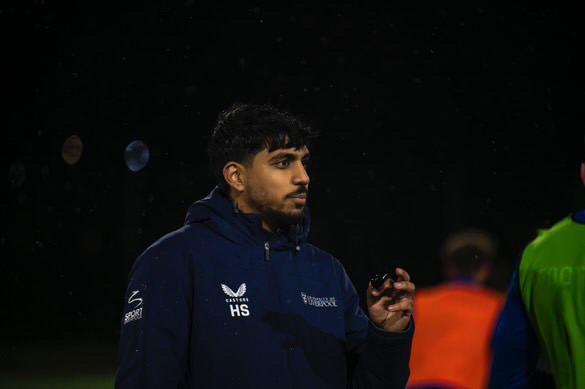
Haysam Shakeel, University of Liverpool FC first team head coach

How many South Asians are in the top five leagues of football? If you struggled to name any, it’s because there are none. Out of a population of almost 2 billion, not a single South Asian currently plays or coaches at the highest level of European football. In the UK, where South Asians make up over 3.4 million of the population, only 22 are in the professional game, just 0.25% of the total number of professional footballers.

This begs the question: why?

For years, the narrative has been that South Asians simply aren’t interested in football. But this argument falls apart when you consider that football is one of the most popular sports across the Indian subcontinent and within British South Asian communities. A recent survey from Sport England showed more than twice as many British South Asian adults played football compared to cricket. So, if the passion exists, why aren’t South Asians making it to the professional level? 

This is what I discussed with Haysam Shakeel, a South Asian football coach determined to break through the barriers.

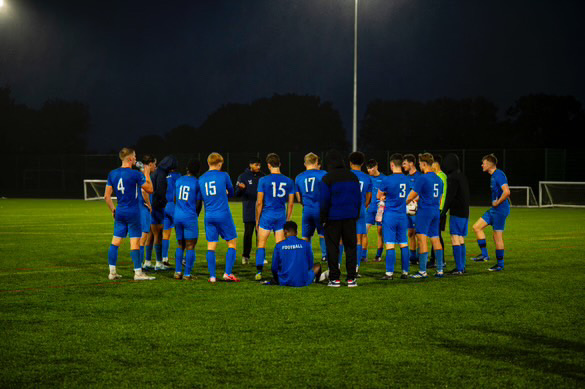
Haysam’s coaching journey began at Manchester City’s academy in Abu Dhabi, where he gained invaluable experience working alongside top-level coaches. When he moved to Manchester, he continued his association with the club, further refining his coaching philosophy. Now, while pursuing a Philosophy degree at the University of Liverpool, he has taken on a significant role as the head coach of the university’s men’s first team, a rare achievement for someone so young.

University of Liverpool First Team

We spoke about the challenges of stepping into such a high responsibility position at a young age. Managing players who are the same age as him, and in the same stage of life, has created a unique dynamic, one that requires a careful balance of authority, leadership, and camaraderie. But that’s just one of many challenges he has faced in his coaching career.

Beyond his personal journey, Haysam also shared his ambitions for the future. He is committed to breaking institutional barriers that have long prevented South Asians from reaching the highest levels of football, both as players and coaches. Drawing on his own experiences, he offered valuable insights into the systemic reasons behind South Asian underrepresentation in the sport.

Through our conversation, he painted a clear picture of the struggles South Asian footballers and coaches encounter, from limited scouting opportunities and ingrained stereotypes to the lack of a clear pathway into elite-level coaching. But he also highlighted what can be done to change the narrative and ensure that the next generation of South Asian footballers and coaches have a fair shot at success.

I want to pave the way and give coaches who are under-represented a chance to express themselves, on and off the pitch

– Haysam Shakeel

You can listen to the full interview with Haysam on Spotify at Liverpool Politics Hour

Featured

“Back then, there was nothing else to do!” – DuoVision, Queer Communities and the Importance of Clubs in the 1990s

By Harry Ashcroft

11th February 2025

Gallery image by Rob Battersby, from OpenEye’s website

This week, I had the absolute honour of speaking to artistic duo Martin Green and James Lawler, known together as DuoVision. They currently have three ongoing exhibitions: Outlaws at the Fashion and Textile Museum in London, The Holly Johnson Story at the Museum of Liverpool, and the focus of my interview with them, For Your Pleasure: 15 Years of DuoVision at the OpenEye Gallery.

The exhibition uses photography and film to “reflect on and celebrate the fledgling queer club culture of the 90s in the UK”. Martin spoke to me about his past experiences as a DJ and running the London club Smashing in the 90s, as well as how he and James met and began creating exhibitions together. They felt that certain artists had been neglected, overlooked and gone out of fashion despite contributing to the UK’s cultural landscape, and for them, DuoVision was about showcasing these artists to an inter-generational audience.

“(Smashing) was a club for misfits… and a lot of gay misfits – but a lot of those misfits ended up having huge pop careers”

– Martin Green, one half of DuoVision

Gallery image by Rob Battersby, from OpenEye’s website

We discussed the cultural movements of the 90s and the ‘straightness’ of the arts compared to the preceding decades. Martin and James explained the devastating effect that the AIDS epidemic had on queer culture in the UK and the importance of clubs in providing connections and safe spaces for these marginalised communities.

“Combination therapy (for HIV) didn’t come in until 1995… the first part of the 1990s was still a difficult time – you still had a Tory government… (and) the antithesis to that – all those awful things – was going out and clubbing”

– James Lawler, one half of DuoVision

These marginalised and LGBTQ+ communities experienced prejudice from both the Conservative government and the mainstream culture and it was simultaneously fascinating, upsetting and hopeful to hear Martin and James recount these experiences combined with the other factors listed above.

Gallery image by Rob Battersby, from OpenEye’s website

We moved on to the methods of experiencing art and the way this has shifted with the advent of new technology. James touched on their method of printing large pictures to immerse audiences in the art, a practice that forces people to reflect and react to art together. I found the entire discussion extremely captivating, and I like to think James and Martin felt the same.

“(The 90s) get retold, and I wanted to tell it again but from my perspective, which was a kind of art school, underground, queer perspective”

– Martin Green

This article is an adapted version of a Politics in Motion radio interview. You can listen to the whole interview on Spotify and below.