The Military Coup of Myanmar: A battle for democracy

Written by Saffron May-B
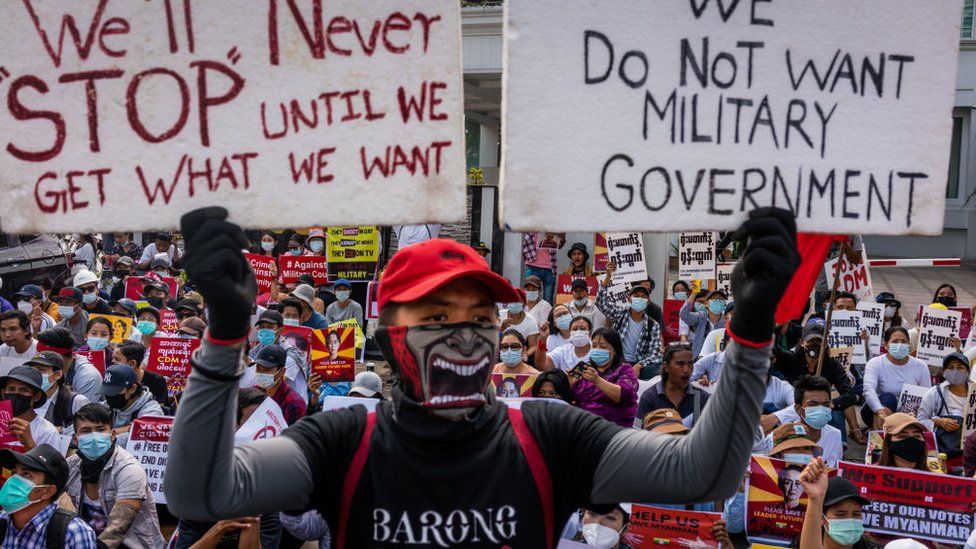
Myanmar coup: Protesters face up to 20 years in prison under new law - BBC  News
GETTY Images

It has been a heart wrenching  two months for the people of Myanmar since the military usurped the country’s first democratically elected leader Aung San Suu Kyi, along with the rest of the National League for Democracy political party. They had just won their second term when, on February 1st,  army general Min Aung Hlaing seized control and imprisoned several high ranking officials along with the leader.

Since then, civilians have flooded the streets in protest of the uprising and have been met with some horrific acts of violence by the newly emboldened military.  An international student from Myanmar told the Politics Hour that civilians in her home country were being wrongfully imprisoned, tortured, and killed on a regular basis. As I am writing this, the death toll is over 700 people, with the deadliest day on record having 114 citizens, 11 of which were children, losing their lives. 

“We’re exposed to a lot of atrocities on a regular basis…the Burmese people around the world are seeing bleeding people on social media or in front of their eyes every day”

This is a humanitarian crisis unfolding before our eyes and the sentiment felt by the people of Myanmar is that the world at large does not care. Or at the very least, does not care enough to warrant a meaningful response. In spite of statements made against the actions of the military made by state leaders around the world, including Boris Johnson, they are still being acknowledged as the government of Myanmar, as opposed to the National Unity Government, which is the leadership that the citizens at large actually recognise. This means that they have an even bigger platform from which they can push their own agendas and propaganda.

However, the feelings of frustration, anger and sorrow are accompanied by resilience and defiance against the new rule, with citizens still protesting through civil disobedience and key worker strikes, in and amongst all of the chaos.

Even prior to the coup, the military was already very much integrated into many different factions of the government. Making the take over, even from a power prioritising view, unnecessary. The lack of tangible consequence to their actions has only made them secure in the knowledge that they can go even further with their agendas and violence, whilst still remaining comfortable in the international community.

To show the bigger picture of we can and do defer back to international political theorists, whose job it is to find patterns in what seems to be utter chaos. I spoke with Dr Nicholas Lees from the University of Liverpool, who looks at these types of conflicts as they occur around the world. Clearly, internal human rights abuses are nothing new, but the existence of international peacekeeping bodies should in theory have a hand in stopping them. The challenge they face however, is if the state resists involvement from an international body, the only option to continue would be through a forceful military intervention, which are famously unpopular due to a perceived lack of success.

For now, the best thing that we as an international community can do is continue to show support for democratic movements in Myanmar. The people are having to fund their own defence force and federal army in a David and Goliath-esque situation, so falling short of humanitarian intervention, providing aid should be a top priority.

Listen to both interviews in the extended feature here on the Liverpool Politics Hour Spotify page.

Salmond’s Alba Party: Bane or Boon for Scottish Independence?

By Fergus Llewelyn Turtle

Alba Party logo: By Source, Fair use, https://en.wikipedia.org/w/index.php?curid=67234612

The last few months have been nothing if not dramatic from Scottish nationalism. Rarely in politics do two figures as close as Alex Salmond and Nicola Sturgeon once were fall out so fiercely or so publicly. Just when Sturgeon must have hoped that the saga was coming to an end, with an independent report clearing her of breaking the ministerial code, Salmond announced he was launching a new political party to fight the Scottish Parliament elections in May. Seemingly this spelled potential disaster for the SNP with a real risk of splitting the pro-independence vote. Salmond, however, claimed it would do no such thing and would instead help produce a ‘supermajority’ for independence which he says will be crucial in getting a second referendum on independence.

How could he credibly make such a claim and how accurate is it?

The answer lies in Scotland’s electoral system; the ‘Additional Member System’ or AMS. This system is a mix between first past the post (FPTP), where 73 districts each elect one person who gets the most votes, and a proportional list (PR) system, where parties are given ‘top-up’ seats to try match their percentage vote. This means that if a party wins lots of FPTP seats, like the SNP, it makes it less likely they will pick up extra seats on the list. On the other hand a party that finds it difficult to break through in individual FPTP seats, like the Scottish Greens, will get more seats from the list.

Crucially the Alba Party has announced they will only stand on the list, urging SNP voters to lend them their votes rather than ‘waste’ them. This idea of ‘gaming the electoral system‘ has been floated for some time in Scottish nationalist circles.

Is this strategy likely to be a success? Well it rather depends, not only on how much support Alba gets, but where that support comes from as they could well cost other pro-independence parties seats.

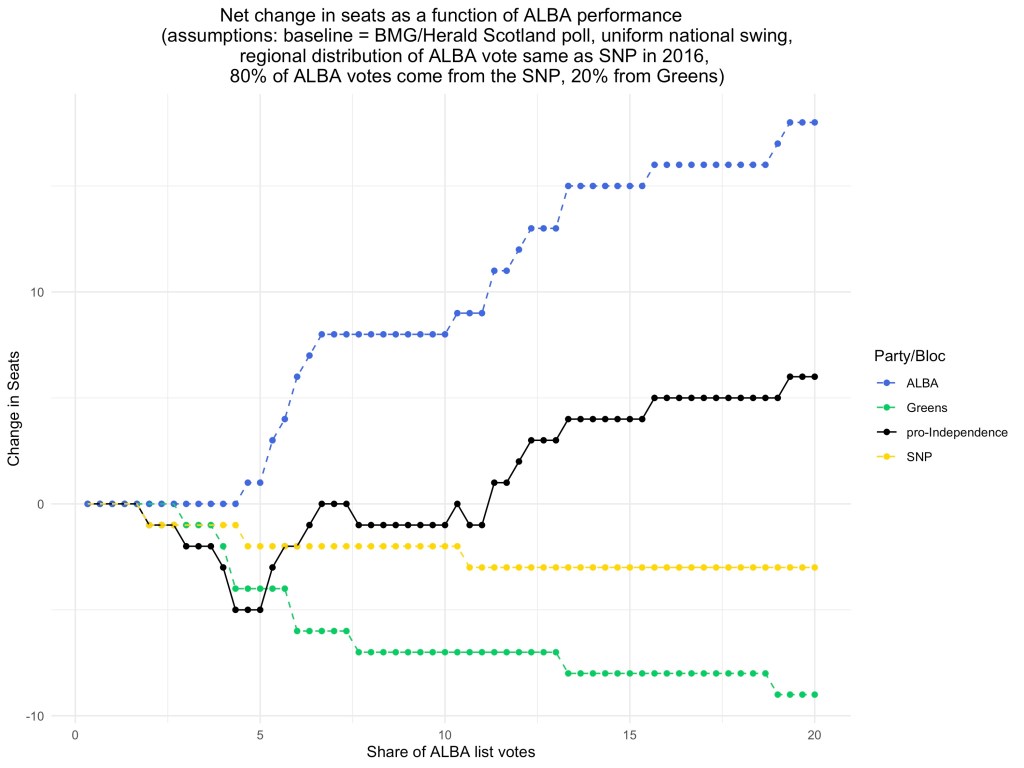
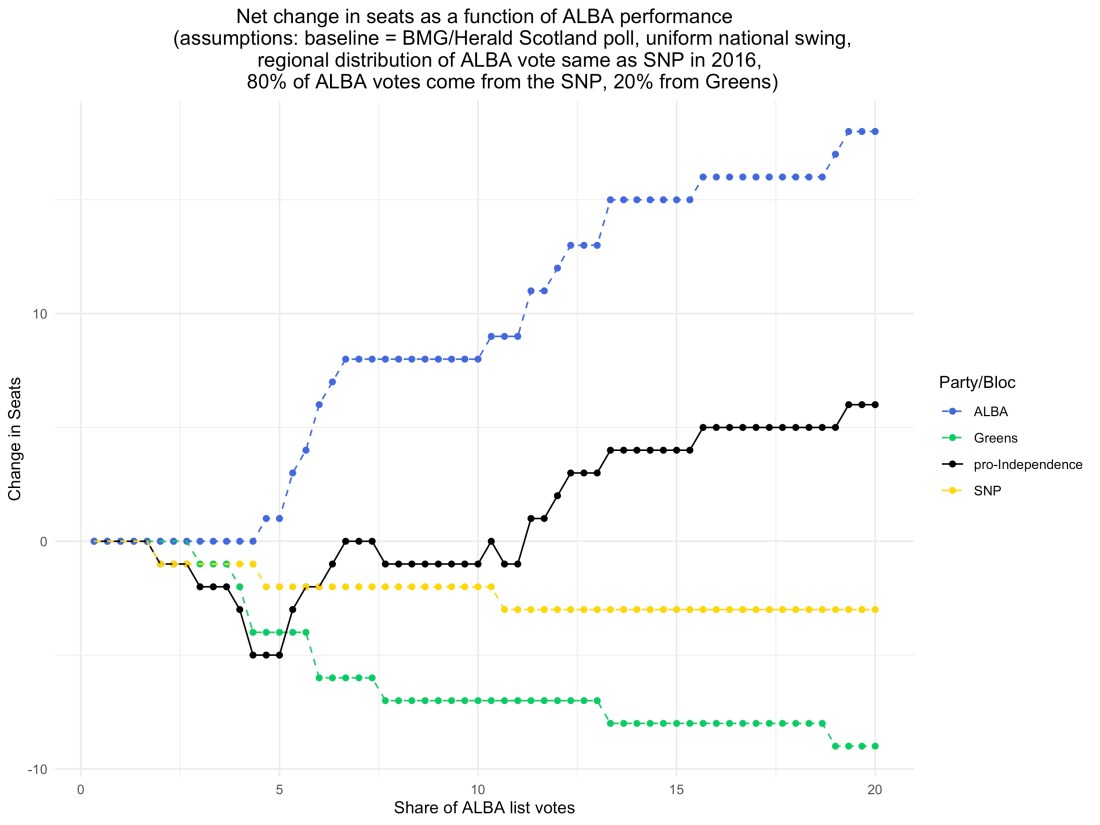
According to modelling analysis by Oxford University Doctoral candidate Leonardo Carella, if Alba were to take votes only from the SNP they would still need to get about 6% of the list vote before they produced a net negative to the total independence seats. Even then they could cause the SNP to fall short of an overall majority, which could make it harder to get a second independence referendum.

The situation could be even worse if we take into account the Scottish Greens, who also support independence and have long benefited from FPTP SNP voters switching to them on the list. If only 20% of Alba voters would have otherwise voted Green, Alba could need more than 11% before they start help rather than hinder the size of the pro-independence caucus.

Of course all of this could change if Alba can attract voters over from unionist parties They could also concentrate their vote in certain areas as the lists are divided into 8 regions. It does look like the party has a large mountain to climb, however. In the two opinion polls to come out since Alba’s launch the party only registered 3% and 6% support respectively on the list voting intention.

Furthermore Salmond’s personal approval ratings are low and he and Sturgeon’s falling out has cost the independence cause support. It’s very possible him being back on the front line of Scottish politics puts more voters off the idea of independence than it brings on board. It seems then a challenging task for Salmond’s new outfit to achieve what they set out to and become a genuine driving force to get Scottish independence across the line, albeit a challenge the former First Minister seems determined to rise to.

The Isolation Podcast: A Politics Hour Reunion Episode

Charlie, Chris and Juliana interview Alistair Campbell for the Isolation Podcast, April 2020.

By Stuart Wilks-Heeg, Reader in Politics, University of Liverpool

Just over a year ago, an abrupt and radical transformation began in how universities deliver education. Covid was, of course, the catalyst. Staff and students alike were forced to adapt to online teaching and learning. Some adapted better than others. There was, and still is, a great deal of innovation, but also much desperation.

This is the story of one of the innovations this sudden ‘pivot’ to online learning gave rise to. Unusually, it was a learning innovation entirely conceived, initiated, and developed by three undergraduate students.

Presented by Juliana Christianson, Chris Flavell and Charlie Millward, The Isolation Podcast first aired on 23 March 2020, shortly before Boris Johnson’s initial ‘stay at home’ order that evening. The podcast was a spin-off from my third year undergraduate module in political broadcasting, which produces The Politics Hour.

Earlier that day, I had caught up with all the students on the module via Zoom. It was the first time we’d been able to meet since they had, mostly, headed back to their parents’ homes. I’d said that we could try to continue broadcasting remotely, but it would be challenging without access to the campus radio studio. Besides, most students had already produced enough content for the module through their weekly shows they had broadcast from early October to mid-March.

But, ever the optimist, I floated the idea of maybe attempting a podcast or two. After all, Covid clearly represented an enormous political challenge, meaning that there would be a great deal to unpack. I wasn’t really expecting an enthusiastic response to this idea. But then I hadn’t counted on Juliana, Chris and Charlie. They didn’t want to make a podcast or two. They had other ideas entirely.

From 23 March to 5 June 2020, the trio released 35 episodes of what came to be known as the Isolation Podcast. The vast majority of these episodes were produced daily between late March and late April. The podcasts covered the unfolding politics of Covid and the impact of the pandemic on schools, universities, broadcasting, the local press, live music, premier league football, charities, the hospitality sector and more.

Guests on the podcast included: Alistair Campbell, Downing Street Director of Communications and Strategy under Tony Blair; Claire Hamilton, BBC Political Reporter for Merseyside; Arif Ansari, Head of News at the BBC Asia Network; Liam Thorp, Political Editor of the Liverpool Echo; Tom Heaton, the Aston Villa goalkeeper; Michelle Langan, founder of the Paper Cup Project; Frank Cottrell-Boyce, novelist and screenwriter; and Ian Byrne, Labour MP for Liverpool West Derby.

A year on from the launch of the Isolation Podcast, I brought Juliana, Chris and Charlie back together on Zoom to reflect on the experience. In a special episode of the Politics Hour, they detail the origins of the podcast, their motivations in starting it, how it evolved and what they took from the experience. Highlights from the podcasts underline how ambitious the enterprise was and the quality of the output that was produced.

The value of the podcast in sustaining the three of them through lockdown is apparent. Covid robbed an entire cohort of undergraduates of the usual stress, camaraderie, anxiety, thrill and euphoria of their final three months at university. But Juliana, Chris and Charlie found a way to reproduce that emotional rollercoaster via the internet while dispersed across Liverpool, Chester and North Wales during lockdown.

We also learn how Juliana’s A-level Politics teacher challenging her to get a high-profile political figure to speak at her school resulted in Aston Villa fan, Charlie, receiving a 21st birthday video message during lockdown from Villa goalkeeper, Tom Heaton. In a phrase beloved by football manages, sometimes you make your own luck.

I first created the Politics Hour with a different group of undergraduate students in 2016. The idea was to try to grapple with the unpredictable and volatile nature of political developments in a way that conventional approaches to university teaching and assessment can struggle to deal with.

I had obviously never imagined that, in 2020, it would spawn a student-led podcast responding on a daily basis to the politics of a global pandemic. I’m grateful to Juliana, Chris and Charlie, as well as to all the guests who appeared in the episodes of the Politics Hour Isolation Podcast for reassuring me that I was onto something.  

The Isolation Podcast Reunion is available to listen to on SoundCloud or Spotify.

The entire Isolation Podcast series is also still available on SoundCloud and Spotify.

Models of American Electoral Politics: 3. The Contemporary Context

This is the third in a three-part series discussing the various models of periodisation of American electoral politics and their applicability to the contemporary United States’ political context. The first part can be read here and the second can be read here.

In this blog post we’ll consider how two models – the party system model and Leybovich’s model – can help us understand the modern US political context: What predictions do these models make about the future? Did their predictions about the recent past come true? And if so, does that mean they can be trusted looking forward?

Party system model

The significance of this model lies more in the start and end dates of each party system than the actual content of each. If the model holds water, the beginning of the 6th party system will directly influence whether we should expect any significant changes to be happening today. Party systems one, three and four (discarding the second as an outlier) each lasted an average of 36 years. If we assume the fifth party system (which started in 1930) was extended by ~10 years due to the Great Depression and FDR’s two extra terms (for a total of 46 years), then its end date is 1976, and the sixth party system started with the election of Ronald Reagan in 1980.

Therefore, 34-38 years after 1980 is some time around, well… now. Brewer and Maisel argue that the Democratic and Republican re-alignments following Trump’s 2016 victory may well constitute a seventh party system: how exciting! Short of a dramatic overhaul of the US electoral system, I’d be very surprised if we saw any real change from the way states have been voting in 2024 onwards; it’s been pretty consistent since the nineties – high levels of partisanship have shored up historical ‘lean’ states, with only ten or so casting the decisive electoral votes. But it’s not about the content of each party system; it’s about their timings.

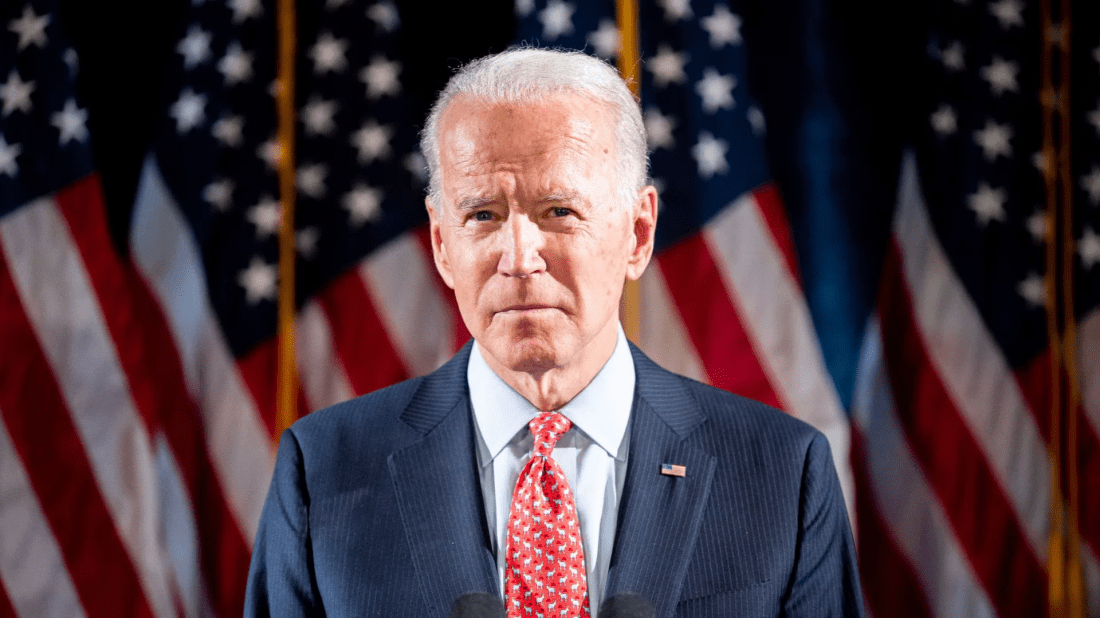
It could be construed that Joe Biden’s victory has come at the same time as the start of a new party system. Is this consistent with other periods of history? Well… yes. New party systems tends to emerge as a result of political re-alignment. This re-alignment results in the rejection of one party (usually the one that dominated the previous party system) in favour of the other, just as we saw in 2020: the Republicans (who dominated the sixth party system) were rejected in favour of the Democrats.

Leybovich model

Leybovich’s model backs this up. Reagan was the transformer – he reshaped the GOP and spearheaded the modern conservative movement. His VP, George H. W. Bush, then took over and continued many of Reagan’s policies. Clinton was the triangulator – a more moderate Democrat in response to the conservative environment. George W. Bush was the reimaginer, Obama was the precursor, and Trump was the ender. Trump fits the role of ender well, offering an outdated impression of Reaganism. Biden, the incoming transformer then, should reshape the political environment. Will he be a great unifier? A transformational progressive? Will he finally tackle the climate crisis?

There’s been a sentiment for some years now that Democrats and Republicans are the same: they’re both fundamentally capitalist, statist, and only really differ on their limited definitions of freedom. This is how both parties can claim the same essential values, while still repeatedly squabbling. Although this concept is rather stale at this point in time, America stood before a great precipice in November 2020: the choice voters faced couldn’t have been more stark. The Democratic Party has become increasingly left-wing over recent years, while the Republican Party has gone “from a moderately conservative party to a very conservative party to something else entirely,” culminating in the storming of the United States’ Capitol building in January 2021.

Platitude aside, Joe Biden is to contend with the highest levels of polarisation within the American electorate since the days of the civil war. This has been especially true amongst Republicans – increasingly untrusting of their leaders, it’s no wonder a divisive, anti-establishment figure like Donald Trump has so successfully reshaped the GOP. So how is Joe Biden to bridge this divide and repair this fractured nation? Even before the Capitol Hill riots, it was claimed that deepening partisanship was threatening he stability of the US. Others have argued that racial divisions, climate change and the COVID crisis among a raft of other issues have broken the US. Biden’s first weeks as president may be previewing a much more progressive direction for the Democratic Party. And this might just be what the USA needs in order to be fixed.

Read the earlier blogs to understand more about the party system model and the Leybovich model.

Models of American Electoral Politics: 2. Archetypes

This is the second in a three-part series of blogs discussing the various models of periodisation of American electoral politics and their applicability to the contemporary United States’ political context. The first part can be read here and the third can be read here.

Following on from the first blog in the series that looked at party systems, this blog considers presidential archetypes for a different perspective on the US political context. Research conducted by Misha Leybovich – what I will term the Leybovich model – both challenges and corroborates the party system model by considering the presidents themselves rather than the electoral science of their accessions.

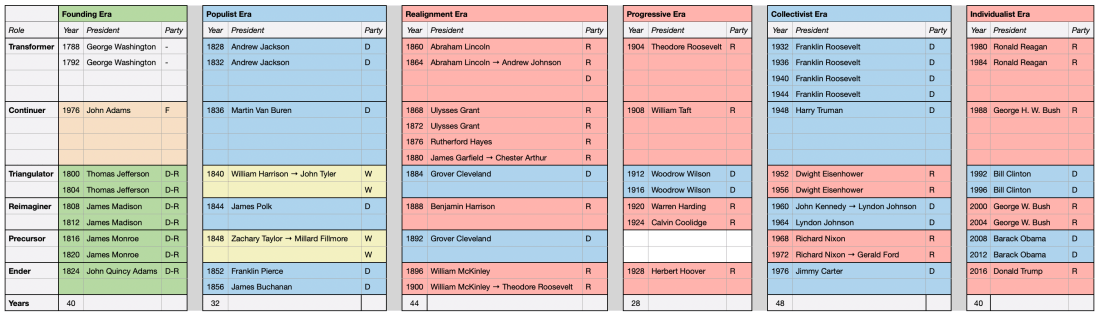
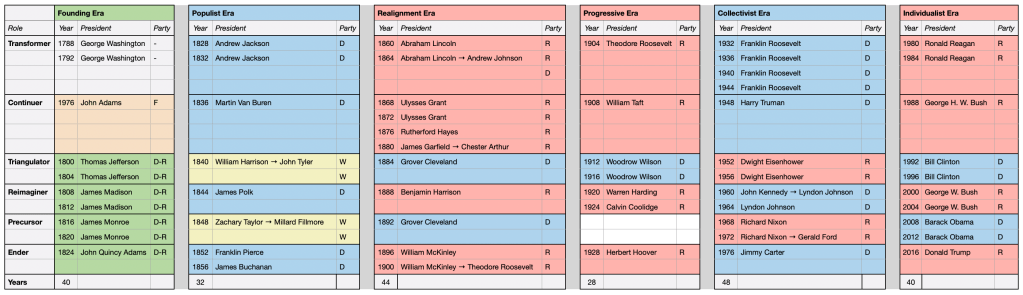
According to the Leybovich model, the archetypes of presidents go through a cycle every 30 to 40 years, represented by a transformational leader at the start of each. As Leybovich notes, “[They] defined the political conversation for the next several decades.” This distinction is important, I feel; not only did these presidents transform politics in their own time, they also left a legacy that sustained their influence years after they left office. I’ve transcribed Leybovich’s spreadsheet and made a few tweaks for ease of understanding, but the idea is much the same.

The cycle is as follows:

  • Transformer – brings a revolutionary new outlook to the political environment that will define the era.
  • Continuer – the transformer’s sidekick, who carries on their legacy with similar ideas.
  • Triangulator – a response from the opposing party to the re-alignment.
  • Reimaginer – does what it says on the tin: they re-imagine the transformer’s original ideas.
  • Precursor – can’t quite bring about any transformation change, but they do foreshadow the outlook of the next era.
  • Ender – presents an expired impression of the transformer’s initial ideas, to lose re-election to another incoming transformer, beginning the cycle again.

This model actually backs up the regular political re-alignments that classify party systems – after all, there’s no rule that these patterns should occur so regularly – but like the party system model, it is important that Leybovich’s model is duly critiqued.

It should be noted that the two eras that fit the model best are the two most recent – what Leybovich terms the ‘collectivist’ and ‘individualist’ eras – begun by FDR and Reagan, respectively.

The first era, which he calls the ‘founding’ era, is definitely the messiest. James Madison – who, according to the model, would be a ‘reimaginer’ of Washington and Adams’ policies, was definitely more akin to those on either side of him – Jefferson and Monroe. The model would categorise Monroe as a precursor to Andrew Jackson. However, Monroe presided over a period of high bipartisanship – “the era of good feelings”. While Jackson, transformative as he was, was deeply divisive and is the root of the modern party divisions.

In comparison, the second era is sparse and brief, but this could be explained by the rising tensions that would lead to the civil war. Further, history shows that Zachary Taylor and Millard Fillmore were hardly precursors to Lincoln. However, the fact that separate study supports the existence of a brief second era further reinforces that the party system model also had a shorter second party system.

The third era sees Lincoln followed by four ‘continuer’ Presidents and Grover Cleveland supposedly fulfilling the roles of both Triangulator and Precursor – he definitely wasn’t the latter because he and Teddy Roosevelt didn’t agree on much.

The fourth, ‘progressive’ era is tricky because it happened at a time when both parties were re-aligning away from their 19th century platforms to their present ideologies. Woodrow Wilson didn’t ‘triangulate’ TR. This era also lacks a precursor to FDR. Even if Calvin Coolidge was substituted out of ‘Reimaginer’ and into this spot, it wouldn’t really fit.

Timings of Leybovich’s cycles roughly line up with party systems. But as described, the roles ascribed to the different presidents are far from perfect fits.

Personally, however, I find that application of the Leybovich Model provides a fascinating insight into the roles played by each president. By challenging the model we can question assumptions and understand some of the underlying trends and forces that have shaped US politics over the last 200+ years.

In the third and final part of this series, we’ll consider how these models influence our understanding of the context in which Joe Biden will operate as he settles into the role of President.

This was the second in a three-part series of blogs discussing the various models of periodisation of American electoral politics and their applicability to the contemporary United States’ political context. The first part can be read here and the third can be read here.

Models of American Electoral Politics: 1. Party Systems

This is the first in a three-part series of blogs looking at various models of periodisation of American electoral politics and their applicability to the contemporary United States’ political context. The second part can be read here and the third can be read here.

In this blog we will look at the concept of a party system.  Of course party systems aren’t solely applicable to the US context. Party systems exist in many countries around the world, but having a handle on party systems provides a useful tool for studying how the country’s politics has evolved.

The most well-known definition of a party system is Sartori’s. He described it as: “The system of interactions resulting from inter-party competition.” But I find this tautological, doing little to help us ascertain the taxonomy/nomenclature of a party system. Others have gone further. Duverger, for example, argues that a party system is defined by the relationship between a number of characteristics of political parties: “Respective sizes, alliances, geographical localisation, political distribution and so on.” From this, it’s logical to infer that the issues of the day and party ideology are key parts of a party system – both factors which change over time. Therefore, party systems are a way of periodising US politics. Each system or period is characterised by distinct party ideologies, support for these parties, and the geographic concentration of that support. A party system can be thought of as a length of time as much as anything else: labels for electoral epochs.

For instance, the issues of slavery and reconstruction dominated US politics between the 1850s and the turn of the century, when the progressive movement began to take root. After 1900, the Republicans – who had once orchestrated an ambitious expansion of federal power – cemented themselves as the party of big business, while the Democrats – who had opposed those government reforms – slowly transitioned into the increasingly liberal party that implemented Franklin D. Roosevelt’s ‘New Deal’ policies in the 1930s. Both of these periods can be considered distinct party systems. Further, the fact that Southern states had been staunchly democratic prior to the Civil Rights Act, when they began becoming Republican bulwarks, can also help classify party systems.

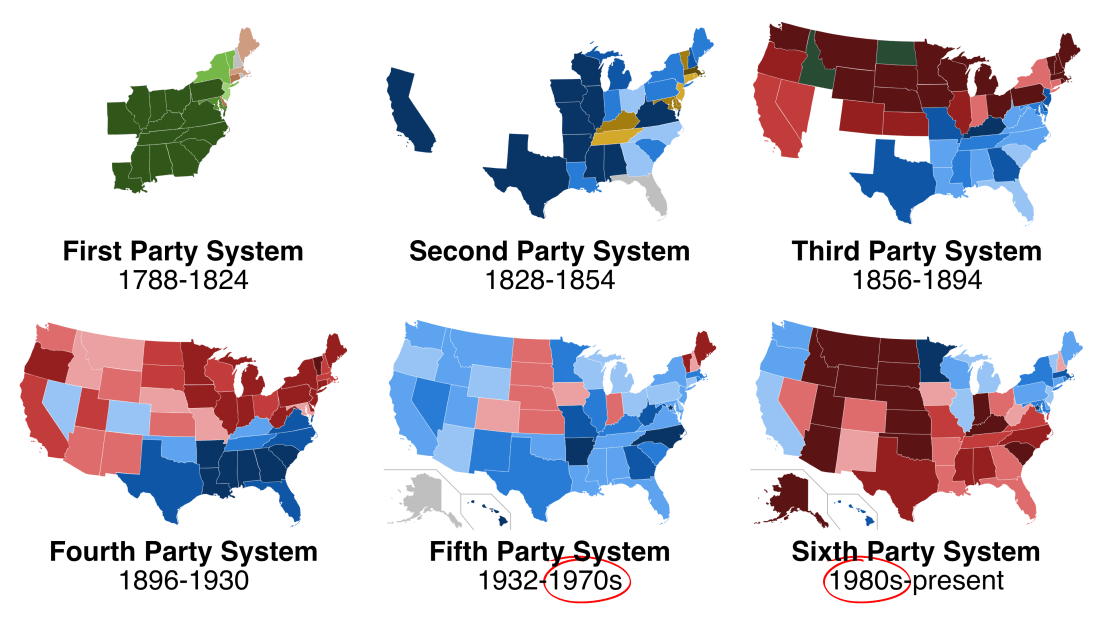
The general consensus is that there have been six such systems since the republic’s founding in 1788 (e.g. Hershey). In the following maps – each denoting a party system – the strength of each colour represents the number of times the corresponding party won that state in Presidential elections between the dates shown.

pastedGraphic.png

The first party system is an obvious outlier. Here, lime green represents the Democratic-Republicans while orange represents the Federalists. These organisations were far more informal than the political parties we know today, and they (mostly the Democratic-Republicans) dominated politics for the first 36 years of the country’s history.

By 1828, the Federalist Party had collapsed and the Democratic-Republicans had divided into supporters of President Andrew Jackson, and his opponents. These would go on to become the Democrats (blue) and the Whigs (yellow), respectively, who presided over the second party system. By 1856, the issue of slavery had come to the fore. The Whigs were divided on the issue, and former supporters ultimately coalesced into the Republican Party (red). Though the Republicans contested this year’s election, their status as a political force was evident with the election of Abraham Lincoln in 1860, truly cementing the existence of a new (the third) party system. Since then, the Democrats and Republicans have traded off control of the Presidency, but their respective ideologies and the geography of their support have also changed.

Although there is widespread academic acceptance of the party system model (e.g. Parties and Elections in America) it’s important that we don’t accept this blindly, and continue to challenge it. A significant inconsistency between party systems is their length. The first, third and fourth party systems each lasted between 34-38 years – approximately 8 or 9 presidential elections. The second, on the other hand, lasted 26 years – only 6 or 7 elections. This discrepancy can be attributed to the collapse of the Whigs and the issue of slavery, although it does point to flaws in the party system model.

There is also some ambiguity over when the fifth party system ended and the sixth party system began. Some have put this date at 1968, 1972, or the 1980s (when both parties’ contemporary identities first emerged). Still others have argued that it was as late as the 90s! If we assume the fifth party system was extended by ~10 years due to the Great Depression and FDR’s two extra terms, then this puts its end year at 1976 (where most academic suggestions average out), and so the start of the sixth party system, could be considered to be the election of Ronald Reagan in 1980.

As shown, despite several flaws, the party system model has nonetheless proved broadly accurate for classifying different eras of US politics – each is distinct, in terms of active parties and the geography of their support. Furthermore, it could be argued that the brevity of one party system or ambiguity as to when a particular system started are not material criticisms in the first place. We are describing human events after all, and human activity rarely compartmentalises as neatly as we might like. Overall, due to the general academic acceptance of the model and that the minor flaws that can be explained away I believe that the model is useful and applicable to the modern US political context.

This was the first in a three-part series of blogs looking at various models of periodisation of American electoral politics and their applicability to the contemporary United States’ political context. The second part can be read here and the third can be read here.

The Divided States of America: How can Biden win over Trumpists?

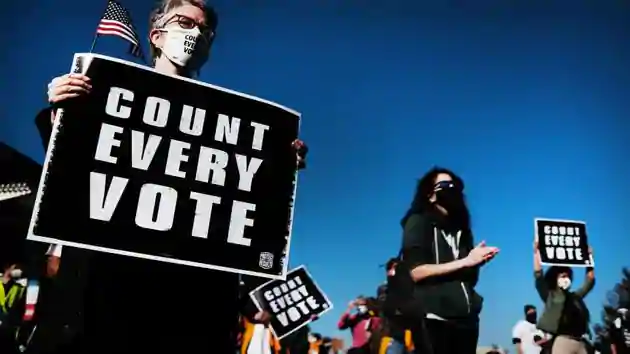
It has been over a month since President Biden took office after winning the election with a record 81 million votes cast for him. In most circumstances, this outcome would be a resounding mandate. However, President Trump, his opponent, recorded the second most votes ever in a presidential election with 74 million votes – 12 million more than in 2016.

The size of Trump’s vote, accompanied with the allegations of fraud by the outgoing President and his legal team, exacerbated the divides America had seen in the prior twelve months.

The deadliest pandemic for over a hundred years, a rise in white supremacy, increasing acts of police brutality, protests, riots, an attempted insurrection along with rising unemployment and a recession makes this the most difficult scenario for an incoming President in modern times. President Biden has pledged to be the President not just for his voters but also the 74 million that voted for President Trump but this will be no easy task. 

The incumbent, President Donald Trump grew his base of support by over 12 million American voters in his term in office despite fluctuating approval ratings and struggling in the polls. This could be a perceived victory for Trumpism within the Repubilcan party as a shift away from globalism alongside a foriegn policy that focused on America as opposed to American influence proved popular particularly with non-voters. 

Alongside this President Trump gained the highest proportion of Black and Latino votes for a Republican candidate in modern history growing both bases since 2016. Most significantly a poll conducted by DemocracyFund found that more than one in five (21%) of black voters aged between 18 and 44 supported President Trump. 

However Donald Trump’s core base remained white male voters despite his share in this demographic shrinking and Biden performed better with women and non-white voters despite his share of the vote in that latter demographic shrinking from Hilary Clintons in 2016. This obviously shows that race remains one of the biggest political divides in America.

Global events in 2020 are likely to have worsened these racial divides despite political divides appearing to show signs of converging. The Covid-19 pandemic has disproportionately affected black Americans whom are 3.7x more likely to be hospitalised and 2.8x more likely to die than their white counterparts. Furthermore black Americans are being vaccinated at a slower rate than Americans from a white background and stark 35% of black Americans claimed they would not accept a vaccination. The pandemic occurred alongside a global resurgence of the Black Lives Matter movement following the murder of George Floyd in May last year, sparking a series of nationwide protests. Following increased opposition to the movement as well as coercive tactics from some police forces these protests escalated into riots – tragically killing 19 people and injuring more than 700 across America.   

Racial divides along with the ever divided election is a sad symptom of the overall divisions between everyday Americans and this was demonstrated a week before Joe Biden’s inauguration where a group of supporters of President Trump broke into the Capitol. The President for months prior has refused to concede the election citing unsubstantiated claims of electoral fraud and unreliability of the Dominion systems used in some states. The hours following Congress ratifying the election results became more toxic with the President turning on his own VP, Mike Pence and even banning both him and his Chief of Staff from the White House. This signified divisions within Republicans across America, between moderates and Trump loyalists.  

To win those moderates over President Biden must place his priorities on ending the pandemic and most importantly for Trump voters rebuilding the economy to place more money in the pockets of working and middle class Americans. This could start with stimulus checks which has been a contentious issue for both Presidents and Congressional leadership however must over the course of the year translate into job creation. If Biden can successfully pioneer an economic restart on a scale wide enough to undo the “double-dip” recession and rise in unemployment this could win over moderate Trump supporters that aligned themselves to the former President on economic issues. 

Failure to stimulate the economy and create jobs across smaller cities and suburbs within the first 12 months of the Biden Presidency could however risk irreversible damage to his time in office, more recession breeds more division. 

President Biden has pledged to heal the divisions of American which he claims were caused by his predecessor. It is very easy to undo the legacy of the former President however to undo the causes that gave him the most powerful office in the world would be much harder. A return to politics that focuses on American influences rather than Americans would not undo these causes. If the President seeks to heal and rebuild he has to tackle the big injustices and inequalities seen in many states, particularly in the rust belt. If he instead opts use the office as a third term Obama presidency America will not have seen the end of Trumpism. 

Return of Chilean Military Aggression?

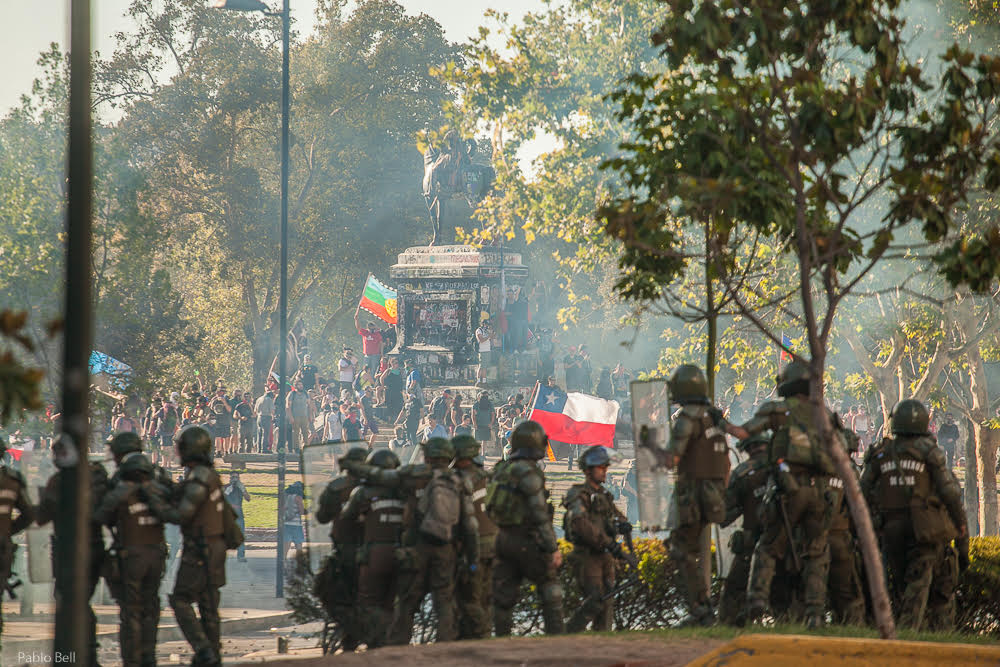
The Chilean protests of 2020 resulted in the death of 36 people, with the Office of the UN High Commissioner for Human Rights (OHCHR) reporting 28,000 people were jailed during the events. Chile, one of South America’s most stable nations in the post-Cold War period, has been relatively free of coups since the 17-year rule of General Augusto Pinochet; whose rule left more than 3,000 people dead and missing. 

This said, the casualties suffered by the social movement have been the worst since the dictatorship. Furthermore, the protests within the last year have seen the rising involvement of the militarised police system inside Chile. Whilst the tactics under Piñera’s government were not the same under Pinochet’s – this rise in violence is worrying for Chile.

The social unrest began back in October 2019, within Chile’s capital city Santiago. What would start as minimal protests surrounding an increase in subway fares, eventually spiralled into an eruption of violence. Piñera’s authorisation of deploying the national police force (the Carabineros de Chile) would mark the start of aggressive clashes between protestors and the Carabineros for several months.

The clashes prompted human rights organisations to allege serious human rights violations. Five human rights reports – authorised by Amnesty International, amongst others – denounced the brutal and discriminative violence of the militarised police. Amnesty International has received hundreds of complaints about serious human rights violations that range from excessive use of force to torture, illegal raids and arbitrary detention. Chile’s National Institute for Human Rights received similar allegations, as well as reports of sexual violence. Exact figures are hard to come by. However, it is reported that there were 194 sexual violence violations in the first two months. 

The number of protestors who suffered eye mutilations as a result of state violence has received much attention. The Instituto Nacional de Derechos Humanos (INDH) places the figure upwards of 427 people. The Chilean Ophthalmology Society state this is the highest number of injuries of this type registered during protests in the world. The injuries were the result of indiscriminative use of riot guns, with Carabineros officers often aiming at demonstrators’ heads.  

The scrutiny directed towards the Carabineros raises questions about their place in today’s society and the decision not to dismantle them after Pinochet’s rule ended in 1990. Since 2017, high-ranking police officers have been investigated for malfeasance, reducing public trust in the Carabineros, which plummeted from 65% in 2009 to 17% at the end of 2019 (CEP surveys). Meanwhile, more than 35 generals who were part of the Carabineros forces have been ousted in the wake of a series of scandals.  

Furthermore, the Carabineros, were never significantly reformed after Pinochet’s rule ended in 1990 and as previously stated are still a very prominent force within society today. It is this connection between past and present that provides an explanation of the continuities and parallels with dictatorship-era repression. It helps highlights that the climate for repression to occur is not fixed and can be carried out in two very different political contexts; both in a military junta as well as a democratically elected government.  

Chile has witnessed its worst civil unrest since the end of Pinochet’s dictatorship. Carabineros’ ever-growing presence within Chilean Society, as well as their increased violence, has now been made visible on the world stage. Their use of aggression violating human rights highlights striking comparisons to the dictatorship of Pinochet and the Cold War period. 

In wake of their continued aggression, somewhat 30 years after the end of Pinochet’s rule, it is clear change needs to come. Whether that be in the form of constitutional amendments, with the current framework allowing the excessive use of force, change in core government tactics in response to protestors or a switch in government. Until then, the legacy of Pinochet and the Cold War will live on today in Chile’s society.   

IS THE UK RACIST?

How long must we wait? Is the end near? Or is history repeating itself?

This investigative episode explores the livelihoods of black and ethnic minority communities in the UK and aims to find out whether racial tensions in Britain are still present. We explore how much has changed for two generations of black and ethnic minority people in Great Britain and discover how racial disparity has shaped the livelihoods and identities of black and ethnic minorities.

In light of the killing of George Floyd, an American father and husband, who was brutally murdered in the hands of the police, sparked tensions across the world.

It is not the first time such events have taken place where the killings and mistreatment of young black men and women fatally lose their lives due to the colour of their skin. But the killing of Floyd was the first time in global history where racism sparked uproar across the world. In fact, the significance of this crime was so volatile, that it diverted attention to racial disparity within Britain. In the midst of a global lockdown due to the coronavirus pandemic, social media platforms were pervaded with racial injustice, extrajudicial video footage of black men and women being murdered by state authority and a social justice movement named as #BLACKOUTTUESDAY which incentivised every social media user to only post a black square to represent solidarity. Being restricted from leaving the comfort of your own home, hundreds of thousands abandoned the government guidelines to march in solidarity across many different cities in the UK. Why? Every race, ethnicity, and diaspora were, as Yaw Owusu put It in our episode, “given a level of strength and new energy for black people, who were saying, you know what… I am sick of this”. Many wanted to ascertain whether racial tensions in Britain were still present and why those who have died in the hands of the police or experienced racial discrimination were not held accountable. The ever-present line from Al Sharpton saying “Get your knee off our necks” immersed around the global atmosphere. Its significance was more than police brutality, but metaphorically envisaged centuries of pain, prejudice, and persecution. How much has really changed in the relationship between black and ethnic minorities and the state? Is the UK still racist and if so, how has this tailored people in society, their livelihoods, their jobs, and their identity? The UK is certainly not innocent for its crimes regarding racial discrimination, unlawful incarceration, and excessive use of force against ethnic minorities.

So, our investigation begins at marking the 40th anniversary of the 1981 inner-city riots in England which sparked form racial tensions between black and ethnic minorities and the police. The weak relationship between the police and ethnic minority communities since the early 30s, illustrated how black and ethnic minorities were susceptible to racial prejudice, the ‘stop and search’ law and many other draconian measures. We speak to Phil O’Brien, an 18 year old photographer at the time of the riots in Toxteth, recalls it as a “Baptism of Fire” which continues to burn today.

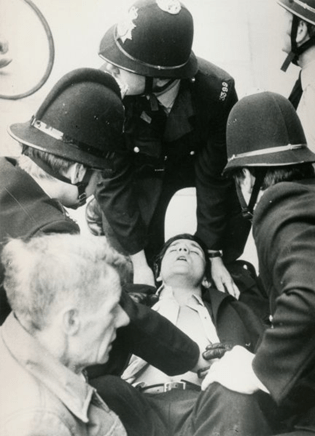
A policeman is tended to by colleagues after being stabbed during a demonstration relating to the Toxteth Riots in Liverpool. ©Phil O’Brien/Mercury Press Agency

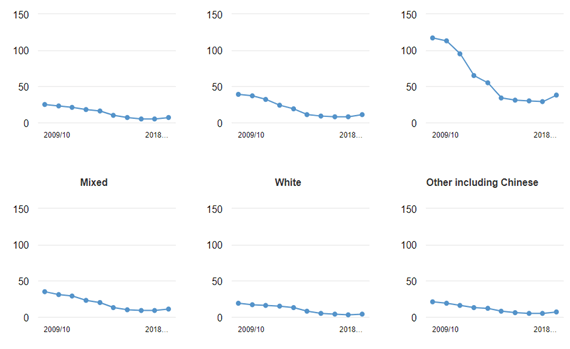
The big two major riots that took place within Brixton and Toxteth, highlighted that the millennial of the 80’s were prepared to stand up against the sectarian acts of the police. The Macpherson report, published after the death of the black teenager Stephan Lawrence, criticised the implementation of ‘stop and search’. The report exposed the Metropolitan Police of “institutional racism” and stressed the excessive use of force and incidence of stops and searches were evidently a clear case of racist stereotyping. As of today, the Metropolitan Police invidious behaviour towards ethnic minorities in the UK was certainly not overlooked by the BLM protestors. Chants of “Mark Duggan”, “SARAH REED”, “Dalian Atkinson” and hundreds of black and ethnic minority lives who were taken away by police officers in the UK, cloaked the atmosphere. The picture has not changed from 40 years ago but mirrors the same bigotry towards ethnic minorities. Statistics show between 2009/10 and 2018/19, for White people the stop and search rate were lower than the national rate every year, whereas in contrast, the rates for Black, Asian and Mixed ethnic groups were higher than the national rate every year. Black African, Black Caribbean and Other Black groups consistently had the highest rates.


Stop and search rate per 1,000 people, by ethnicity over time – Location England and Wales. Source: Police powers and procedures, England and Wales year ending March 2019

Interviewing Leroy Logan, ex superintendent in the Metropolitan Police and MBE, he labels such behaviour is part of the “institutional racism” that continues to pervade the UK police force.  The racial stereotyping that is carried out by officers, is perfectly executed in Steve McQueen’s Small Axe series which illustrates Leroy’s very own life as a black officer working under a discriminatory institution after his father was assaulted by two police officers. The life of Leroy who is acted by John Boyega, demonstrates the black British experience and the battle of advocating better relationships between the police and minority ethnic communities in Britain. He explains to us that although there has been some improvement by the implementation of more officers being recruited from diverse backgrounds and the creation of his charity Voyage that aims to inspire the young black millennial, even to this day “policing attitudes are going backwards”. There is more room for improvement within the police force for not only incorporating diversity but understanding the importance of it. He hopes the Small Axe series “inspires” everyone to realise the institutional racism that takes place within the police force and that is part of public and private institutions.

Source: Time Magazine. The True Story Behind Small Axe: Red, White, and Blue | Time Creator: S Goodwin, Will Robson-Scott
Copyright: Copyright 2019 S Goodwin

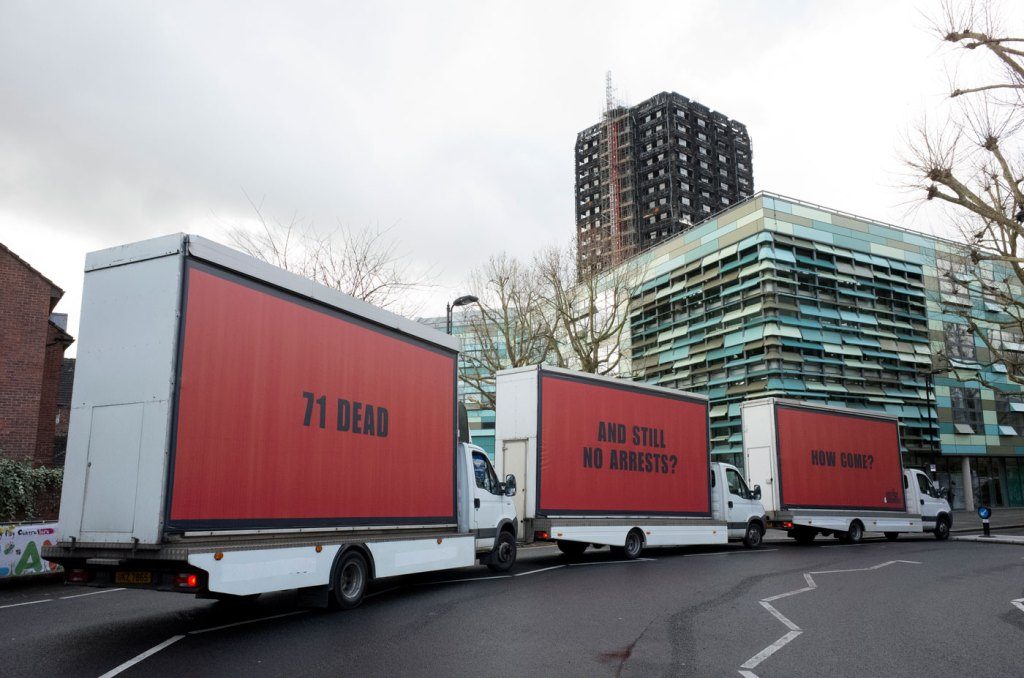
Speaking of public and private institutions, the picture is much bigger than the draconian stop and search enforcements. Institutional racism takes places in many different shapes and forms, a tall block of flats to be exact. On the night of June 2017, the Grenfell Tower situated in one of the wealthiest boroughs in London – Kensington and Chelsea, replicated the inferno of hell. With cladding material on the tower further escalating the fire to spread, 72 residents died in the blaze with no possibility of escaping. Understandably, the tragic event has put the matter of social housing at the forefront of public and government matters. However, with many Grenfell residents being from ethnic minority backgrounds, the question turned to whether the poor response, accountability and slow process by government, councillors, and the construction industry, was racially and socioeconomically motivated. Speaking to Yvette Williams, founder of Justice4Grenfell and witnessing the fire from her living room window, says she heard “a loud bang, screaming and residents shouting for help from their windows”. She also says that as the fire burned for 60 hours, it foreshadowed how slow the response from the government and councillors would be. The Grenfell Tower fire highlights two key important terms, class, and race. The question will always remain whether if residents within the building were a different race and social class, would the matter at hand have been handled much better? Most importantly, accountability is crucial, and it appeared that every political party was responsible for not standing in solidarity to the institutional racism that was evident in this event. Yvette being a proud Labour party member believes they have “failed” in representing what the party embodies – the representation of the working-class and diverse communities. She urges that they must “shut up and listen for once.”, to “listen to cries of the working-class communities” and ethnic minorities in Britain who are consistently neglected.

Copyright: KENDAL NOCTOR

This episode does not just revisit past events, but what is happening at this very moment. Coronavirus. We investigate the livelihoods of ethnic minority communities amongst the pandemic. Does institutional, structural, and systemic racism give reason to the disproportionate rates of infections and deaths of black and ethnic minority communities? The structural racism within the UK has had a greater impact on ethnic minorities, James Nazroo a sociology lecturer at the University of Manchester explains the reason behind the disproportionality. Nazroo explains that “these communities are at a greater risk because the way racism permeates our societies”, the disproportion operates in a number of ways, “it relates to the types of jobs and the geography of where they live”, which clearly shows the marked inequalities that separates minority ethnic communities from the wider society. Prime Minister Boris Johnson and Matt Hancock Secretary State for Health and Social Care are aware of the significant risks these communities face, the majority of key workers being from these communities worked on the frontline in the pandemic in many risk-driven jobs. ONS data reports mortality rates for COVID-19 deaths at the start of the pandemic from the period 2nd March – 15th May 2020 was highest for males of Black ethnic background at 255.7 deaths per 100,000 population and low among White males at 87.0 per 100,000. Similarly, high rates for women of Black ethnic backgrounds were at 119.8 per 100,000 whereas women of White ethnic background were 52.0. The disparity in mortality rates is staggering, Nazroo believes the solution to tackle this is for public and private institutions to recognise the discrimination towards minority ethnic communities in the workplace, applying for jobs, geographical location, and the effects of gentrification. The impact of these inequalities is a catalyst for COVID-19 deaths among black and ethnic minorities.

This short documentary has brought awareness to the institutional racism that British public and private institutions exert. The very same issues 40 years ago regarding racial tensions in the UK, continues to permeate our society today. The racial injustice towards black and ethnic minority communities must be put to an end. No more inquiries. No more reports. It is time to hold accountability to the many elites that have gotten away with extrajudicial crimes. Racism in the UK remains as contentious as it was 40 years ago and even more. If these matters are not attended to then this question will remain at the forefront of discrimination in this country… As David Lammy puts “When? When? Just when will Black Lives Matter again?”

If you would like to find out more about the topics discussed in this episode visit:

Brexit Fact-Check: The Economy, Immigration and The Irish Sea Border

On 1 January 2021, the day finally arrived!

Four and a half long years and two prime ministers later, the Brexit transition period finally ended.

The abundance of (mis)information that frequently surrounds significant political events such as Brexit often leads spectators confused and unenlightened.

This calls for one thing: a Brexit fact-check.

“We send the EU £350 million a week, let’s fund our NHS instead.”

The controversy arises here from the fact that the figure is a gross weekly amount awarded to the EU and does not account for the millions that flowed back into the UK through rebates and the money awarded to schemes in the UK such as the Common Agricultural Policy and the Regional Development Fund.

In light of this, the UK Statistics Authority wrote to Boris Johnson over his repeated use of the number, calling it a “clear misuse of official statistics”. They stated that the real net figure is debatable because of the money returned to the UK from the EU but it is certainly much lower at around £234 million.

The Government has pledged to deliver a record £34 billion per year in additional funding for the NHS in the NHS Funding Act 2020. However, with such a large figure in mind it seems that the £350 million a week awarded to the EU would not have stopped the government spending more on the NHS.

In addition to this, the money we could have saved on EU membership fees has already been earmarked for the divorce bill which the Office for Budget Responsibility has estimated to cost Britain around twice as much as the yearly EU membership fees with an additional 43 years of further payments which will take us to 2064. Therefore, it appears that it will be quite some time before we start making ‘savings’ from leaving the EU, that’s if we ever do.

“Take back control of our borders.”

Without running the risk of sounding like a certain former president, Boris Johnson made a pledge to cut immigration and deny entry for low-skilled foreign workers to the UK.

The Prime Minister’s claim that “the only way to take back control of immigration is to Vote Leave” is a bold statement, but how true is it?

Home Secretary Priti Patel has outlined an Australian style ‘Points-Based System’ meaning that people wishing to migrate to the UK will need to achieve a certain number of points in order to qualify for UK residence, such as minimum annual earnings of £25,600.

It is unknown how many people will actually qualify under this new system and therefore it is difficult to assess how true this statement is currently. However, there appears to be some truth behind it as a new points-based system should see a decrease in net migration to the UK, but perhaps only for low skilled workers.

“There is no Irish Sea border.”

Secretary of State for Northern Ireland Brandon Lewis headed to Twitter to release this stark statement which was met by a huge backlash and demands for further clarity and evidence.

The UK and the EU have agreed on the Northern Ireland Protocol which means Northern Ireland will stay in the EU single market for goods and will continue to enforce EU customs rules and regulations at its ports.

A hardening of the land border with the Republic of Ireland and Northern Ireland has been prevented but a new “regulatory” border with the rest of the UK, complete with customs declarations, inspections and border control posts seems to refute Brandon Lewis’ statement of a complete eradication of the Irish Sea border.

With all of this in mind, one thing is for sure: the effects of Brexit will be felt for years to come and it may be a matter of time before we are able to see the extent of the truth behind some of the statements made in the process.  

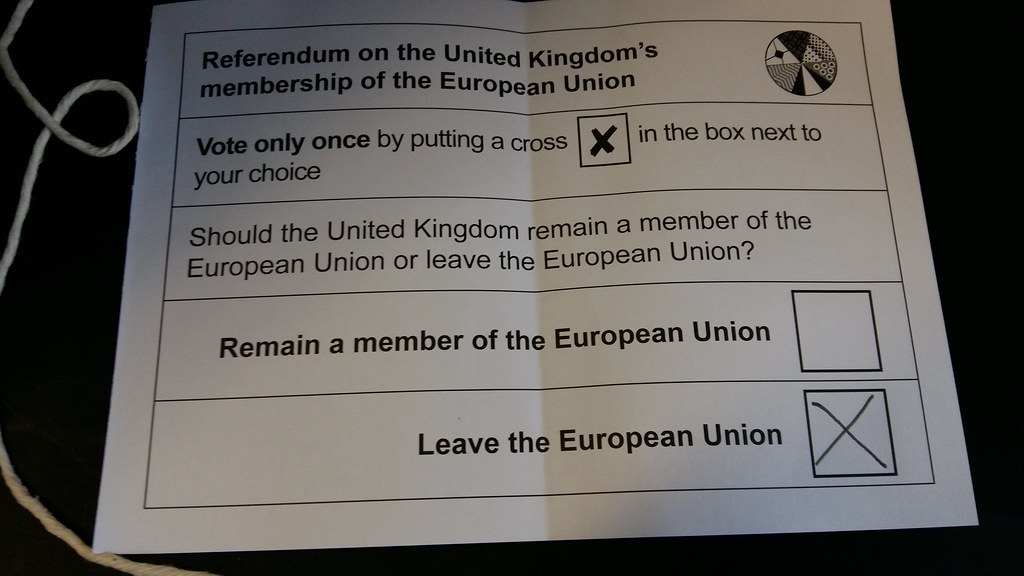
Image: “Brexit” by (Mick Baker) rooster is licensed with CC BY-ND 2.0. To view a copy of this license, visit https://creativecommons.org/licenses/by-nd/2.0/