X-treme in the Streets: How Far is Too Far?


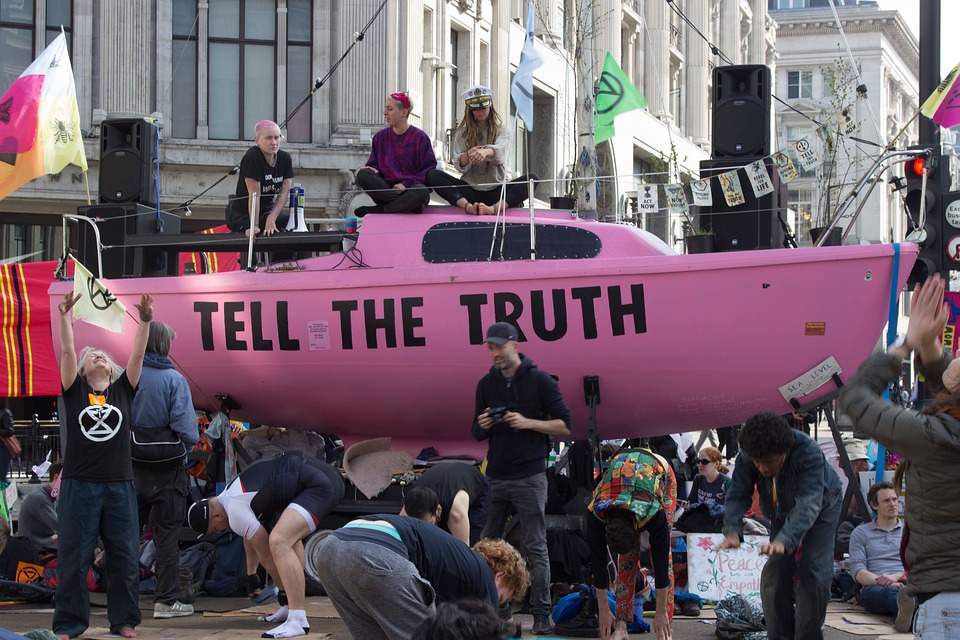
Extinction Rebellion (or XR for short), has come under the spotlight once again following a recent bout of intense protests across London.

Committed to their tactics of civil disobedience, the climate activist group have resisted police force and prevailed wide scale demonstrations to disrupt the capital.

This is to raise awareness of the increasingly urgent climate emergency and challenge the supreme authorities to act accordingly.

Such views are reflective of the growing ‘green radical movement,’ which calls for a top-down approach to resolving the climate threat. It suggests a total de-rooting of the very fibres of our existence: capitalism, elitism and globalisation to name a few.

Last week’s protests saw a wave of placards float across London declaring: ‘system change not climate change.’

Certainly, there is some proof in the pudding. It’s not news that consumerism is harming the planet. In fact, most scientists share a consensus that current global consumption patterns are unsustainable and require evaluation. But how far is too far?

For XR, the radicalism of the protests is reflective of the radical action required to tackle climate change successfully.

In the UK Politics Hour’s latest podcast, we spoke to a protester who had been camping for four days straight on London Bridge in the name of climate awareness.

He presented his commitment as dutiful; he was resilient and ready to combat ruling forces with whatever it took to stand up to climate change. The full interview is available through the link at the bottom.

Like most things to do with politics these days, opinions were split across the nation as to whether XR’s approach was necessary.

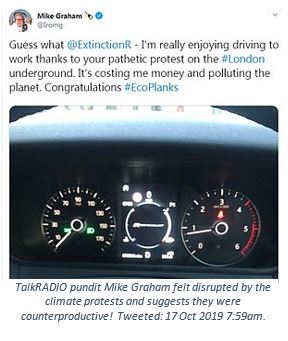
With few more abrasive than an angry London commuter, many responded distastefully to the protesters. Journalist Mike Graham took to Twitter to express his frustration:

tweet for blog

Yet others were not so disapproving of the action. A recent opinion piece in the Guardian stated: “Critics complain that the civil disobedience campaign is unrealistic and disruptive, but its tactics are forcing the public and politicians to confront the climate emergency.”

XR have undeniably been successful in pushing a climate-centric discourse to the forefront of discussions. In just a year of existing, the group have managed to get Britain to declare a ‘climate emergency’ and pushed the government to commit to net-zero emissions targets by 2050. A survey this year also found that 85% of Britons now believe that climate change is a serious threat, compared to 59% in 2013 (Ipsos Mori, 2019).

Indeed, the nation appears to be moving closer to unanimity that we must take global action against climate change. However, the response to the XR protests suggests the means of achieving this are much more highly disputed. Despite the vast number of Brits now supporting climate action, just 17% are opposed to capitalism in Britain (YouGov, 2017).

In the midst of all this debate, what we must agree on is this: climate change is scientifically, bona fide real. We cannot ignore its presence.

We live in a world where natural disaster and not our leaders convince us of the truth.

In the year where US emissions rose by 3.5%, Alaska saw its highest ever temperature, sea levels rose higher than any other year and the Earth’s glaciers lost more than 9 trillion tonnes of ice, we must unite.

Let us work out the logistics along the way, but let us all stand together in the name of preserving our planet and make a global commitment to care for Mother Earth.

Links:

https://soundcloud.com/thepoliticshour2018/the-uk-politics-hour-ep1

https://www.ipsos.com/ipsos-mori/en-uk/concern-about-climate-change-reaches-record-levels-half-now-very-concerned

https://yougov.co.uk/topics/economy/survey-results/daily/2017/09/28/dd1bc/2


Football’s worrying relationship with the gambling industry: Time for clubs to cash out?

It’s a cold, wet and windy January night, as Derby County play host to Stoke City in a bottom half fixture in English football’s second tier – an all-midlands clash which has rather generously been picked for Sky Sport’s Friday night TV coverage. Ahead of kick-off what made this encounter stick out like a sore thumb had little to do with action on the pitch, rather, it was a stark reminder of English football’s cosy relationship with the global gambling industry.

Hosts Derby were handing just a sixth league appearance to their new glamour signing. England record goal-scorer Wayne Rooney had arrived in January from MLS outfit DC United in a deal move that was not without its controversy. The transfer was described by some as a publicity stunt from betting firm 32 Red, who’s involvement in the deal created a sense of unease from many in the game. An abashedly unsubtle marketing ploy from 32Red stipulated in the terms of the player’s contract that Rooney must don the number 32 shirt (Pictured below). The firm were also said to have bought representatives to the negotiating table to push through an agreement would see the 34-year-old immediately named as club captain – a move which caused a sizeable stir among players and supporters alike. However, if any club could claim to have a closer relationship to the bookies than Derby themselves, it would visitors on the night Stoke City, in fact perhaps the only thing lacking in the cocktail of gambling advertising, was the fact was that the match was being played in Derby and not at Stoke City’s Bet365 stadium, the only stadium in the England for which a gambling company holds the naming rights. This is because Stoke’s owner, Peter Coates, is the co-founder of Bet 356. Add to this, the fact that this was a fixture being played in the SkyBet Championship. The UK betting firm (which is conveniently affiliated to the broadcaster which holds exclusive UK TV rights to fixtures across the three EFL divisions) owns the naming and primary sponsorship rights to the 3 EFL divisions – The Championship, League One and League Two. In all 15 of the Division’s 24 clubs don betting company logos on their shirts, down from 17 the previous season.
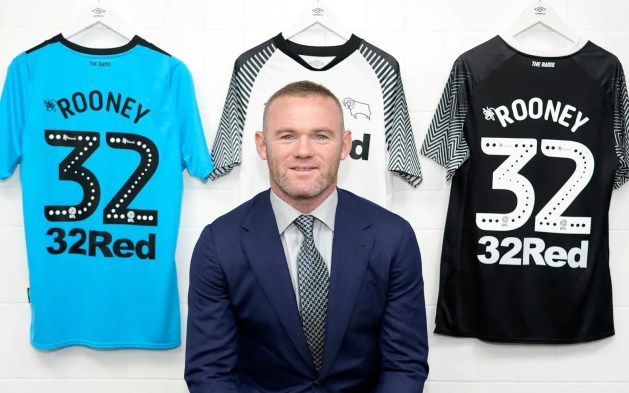
 

rooney number 32


If there is a case to be made for the clubs being sponsored by betting companies, it is that the clubs are dependent on the revenue generated from these deals in order to survive. Taking a closer look at the clubs who have gambling companies on their shirt, we can clearly see that these deals benefit a specific profile of club. In the Premier League, exactly half of the teams in England’s top divisions have betting company’s names on the front of their shirt. It is no coincidence that all of the division’s ‘big 6’ teams (Arsenal, Chelsea, Liverpool, Manchester City, Manchester United and Tottenham Hotspur) decided against giving shirt sponsorship space to gambling companies. However, the fact that all of these clubs still have partnerships with these companies suggests that are reliant upon them, just not to an extent which would put at risk their international reputation by emblazoning them on the front of their shirts. The Premier Clubs who are sponsored by gambling companies make up the majority of the division’s bottom half – 9 out 11 sides from 10th place downwards (with 6th  place Wolves the only gambling sponsored team currently sitting above 10th position) – shows that there is a direct correlation with the teams sponsored by gambling companies and those who are most desperate for  the money. At look Premier League Club’s 18/19 accounts (data below compiled by Kieran Maguire) illustrates the financial chasm between the big 6 and the rest of the league, with this in mind, it is understandable that many clubs look to the bookies to provide revenue.
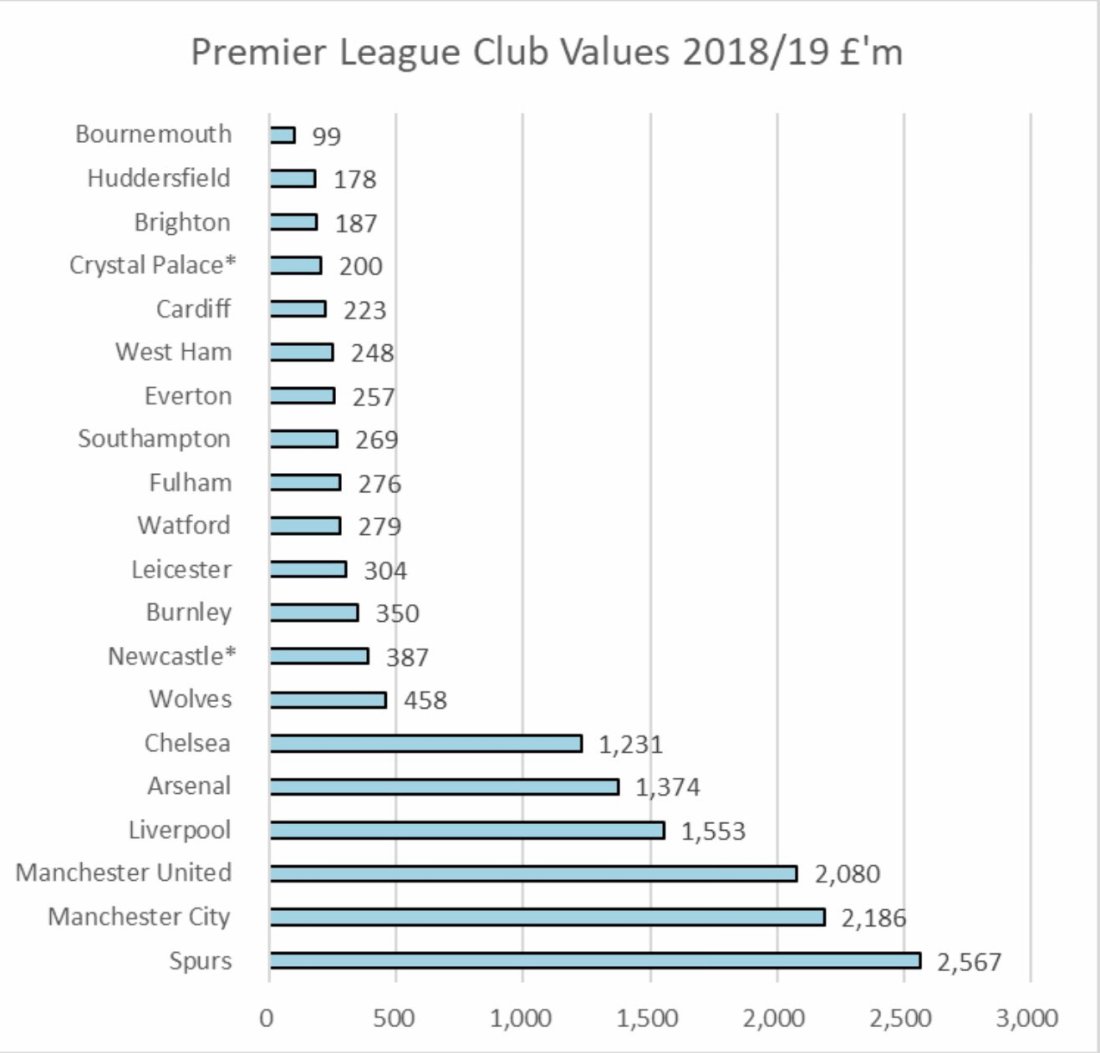
kieron maguire graph

The Championship clubs who not sponsored by betting companies, 8 in all (Huddersfield being the anomaly as they are sponsored by Paddy Power, who launched a high profile campaign at the start of season not to show their logo on any of the teams they sponsored. However, many saw this merely as a publicity stunt), are very much the exception to the rule, and for the most part, there are mitigating factors as to why these clubs have escaped gambling companies clasp on the league. For 5 of the clubs, Luton Town, Barnsley, Charlton Athletic, Millwall and Brentford it comes down to their size. Relative to other teams they are amongst the smallest in the division in terms reputation and value.  The first 3 teams mentioned were only promoted to the Championship last season, whilst Millwall were also promoted fairly recently (2017). Brentford are admired for being a well-run club that is focused on longer term thinking when it comes to financial strategy. Henceforth their avoidance of utilising a gambling company as shirt sponsor could be seen as evidence of this. Another 2 clubs in the Division not sponsored by gambling companies are Cardiff and Sheffield Wednesday. Instead of using shirt sponsorship as a profit making mechanism, both clubs are used by their respective owners as vehicles for their own business ventures and as a result are sponsored by their owner’s companies rather than a third-party.

The fact that only 2 out 48 clubs from the third and fourth tiers – Leagues One and Two, have gambling companies on their shirt shows that securing a sponsorship deal with a betting firm is seen as a highly lucrative venture that is for the most part, only accessible for Championship and bottom half Premier League Clubs. Interestingly the 3 clubs across these divisions sponsored by gambling companies are Ipswich (newly relegated from the Championship) and Salford City (who receive a high amount of media exposure for a club at that division due to the fact that they are co-owned by 6 members of Manchester United’s ‘class of 92’).

It is hard to dispute the importance of that clubs place upon securing these deals. Premier League clubs make an estimated £70m per season from them.  Although the 15 sponsored Championship clubs make less per season from these deals at £45m, they are even more reliant upon them. A glance Championship club’s cumulative finances show that the division’s clubs combined operating losses tallied at £650m. At time where the financial future of clubs is  particularly uncertain clubs appear to be inclined to take anything they can get before questioning the morality of involving themselves in such deals. Speaking to Matt Zarb-Cousin in an interview for the Politics Hour, the director of Clean Up Gambling accepted that clubs dropping these sponsorship deals would require a “Short term calibration” but that there were alternative solutions such as a redistribution of wealth from Premier League clubs and the perusing of new alternative sponsorship. Matt also raised the point commonly levelled at those that have defended gambling advertising on the basis that clubs rely on them. He said that football has to move on from betting sponsorship in the same way that clubs had to move away from Tobacco advertising in the 80’s and alcohol advertising in the 90’s.


For those who are concerned by the presence of gambling advertising in football, there are developments emerging that give cause to believe that the ground on this is changing. This change is coming from forces both within football and those beyond the game. Brand consciousness is one such driving factor. As mentioned earlier in the article, all of the Premier League’s big 6 clubs have avoided using a gambling company as their shirt sponsor. However, it must be said that this could be partly down to the fact that clubs are able to peruse more lucrative ventures, rather than any moral objections. The shirt sponsorship deals for those clubs are worth the most in the league. In February, Everton mutually terminated their deal with SportPesa after the gambling firm had its offices closed in Kenya after disputes over tax affairs. The business had come under fire for fuelling gambling activity in a country where 500,000 young people had to default loans on gambling. In a statement, the Merseyside club said: “this has been a difficult decision but one that allows us to deliver on our commercial plan and grasp new opportunities open to us”. The statement is left open to interpretation, though the phrasing does hint at the club potentially moving away gambling sponsorship altogether. The approach that European clubs outside of England have taken in their response to gambling advertising is one that heaps further pressure on Premier League and Championship clubs to change their ways. In Italy, legislation was introduced last year, enforced from this season, which ruled that clubs could not advertise gambling companies on the front of their shirts. The opposition this received from Italian clubs is testament to the fact that introduce such a measure is unlikely to entirely smoothly, but nevertheless still enforceable. In the Germany’s Bundesliga – where many of the division’s clubs are admired for their smooth financial operations, only two clubs have gambling logo on their shirt. Paderborn 07 as main shirt sponsor and Mainz 05 as a sleeve sponsor.  It is notable that both these clubs are among the smallest in the division.

Whilst the transition of clubs away from gambling advertising is something that is only being done in tentative steps, the same cannot be said when it comes to sponsorship deals cut between individual players and brands. Players are now more conscientious than ever when it comes to their own personal brand and public image. The success of B-Engaged, an agency which explores commercial opportunities with players to improve their own brand shows that there is an appetite for this. Arsenal’s Hector Bellerin is a model example of the type off pitch personality which some players are now trying to reflect. The Spanish right back is vocal off the pitch about issues such as the environment, politics and veganism.


Even if we consider that players and some clubs may be open to change, the decisive action in provoking change is likely to come not from Wembley but from Westminster. Both of the major parties promised a review into the 2005 gambling act in their 2019 election manifestos. If Boris Johnson’s Conservative government falter to deliver on this, they can expect to be held to account by The Gambling Related Harm All Party Parliamentary Group (APPG). The cross party group, led by Labour MP Carolyn Harris (pictured below) but also featuring MP’s from the Conservative Party (such as former leader Ian Duncan Smith), The Liberal Democrats, the Scottish National Party (SNP) and the Democratic Unionist Party (DUP). Speaking to Politics Hour, Matt Zarb-Cousin said that the efforts to coordinate a way to crack down on harmful gambling (including measures to limit gambling advertising in football) “has to be cross party”. On how the government should tackle the issue, Zarb-Cousin said: “The Magnitude of the industry requires a serious response” and that efforts to do this “require a coordinated, joined up approach in government” rather treating it as something they can just “tack onto the end of the department for media culture and sport”. Speaking to the Athletic, Harris did not mince her words when speaking football’s future relationship with the gambling industry: “It will happen, clubs have never been so dependent on gambling companies on the first place”.

carolyn harris

So far, efforts to curb harmful gambling activity have been limited. The Senet Group’s: “When the fun stops, stop” campaign is perhaps the popular advertising campaign which aims to reduce harmful gambling. These adverts are frequently aired during breaks in sports broadcasts. Individual gambling companies are also airing their own adverts discouraging gambling. However, these adverts tend air after events are finished, particularly if they have taken place in the evening. Account controls, including deposits limits and account lockouts in order to restrict harmful gambling have also been introduced by online bookmakers. Zarb-Cousin is sceptical of the intentions of these measures, saying that they primarily have the effect of hooking people into gambling by reassuring them that is safe, rather than helping those that need to curb their gambling activity.

The issue of gambling advertisement in sport may have dropped down on the agenda since the outbreak of COVID: 19 has stopped all sporting activity in the UK, but there remains a feeling of inevitability that this is an issue that will need to be resolved one way or another.


(Words: Max Radwan)

Post Covid-19, how do we digest the grief of a pandemic?

Written by, Kitty Ward.

We have been consistently told throughout the Coronavirus that we are living through unprecedented times and that returning to the status quo seems unlikely. This begs the question what will the new normal look like? And how will it be achieved? The first thing we need to do if we want return to some kind of normalcy is to deal and process with what we have lost while living in the time of Covid-19. Since late January the virus first made headlines we as a society have experienced feelings of grief that we have not been able to fully experience and come to terms with.

Charity Marie Curie has called for National Day to reflect, grieve and remember those who have died from the Coronavirus and other causes, the 23rd of March has been suggested as that is the date when the UK first went into lockdown. The charity estimated that 300,000 people may be grieving for loved ones who’ve died since the UK lockdown began. That’s 300,000 people who have been unable to properly digest and comes to terms with the grief that they fell for loved ones. Under lockdown, funerals are having to adhere to strict social distancing rules, as guidelines state that mourners must keep two metres apart and only members of the same household or close family should attend funerals. This means that friends, extended family, and immediate family who are high risk are unable to attend funerals.  When I spoke to the CEO of Marie Curie Matthew Reid, he said that funerals are important because not only do they provide dignity to the loved one that has passed, but they also act as the closing of a chapter for those who are left behind. Current social distancing guidelines makes this impossible for mourners who may not be able to be with their loved ones at the end of their life or attend their funerals.

Moreover, what does grieving in lockdown look like if the bereaved are not able to rely on their social networks to support them through the sorrow of death? The effects of not having access to the tools to deal with death are great, and the consequences are heavy. Grief can affect the individual both mentally and physically. Mentally the individual can become pre-occupied with thoughts, memories, and images of loved ones, making it hard to process the death of loved ones. The grief can take on physical qualities such as depression, trouble sleeping, loss of appetite, and feelings of anger when individuals feel chronic stress due to their grief. The pandemic has haltered the ability of individuals to deal with the mental and physical effects of grief and has left many grieving alone.

It is must be remembered that feelings of grief can be extended to grieving for the loss of life as we knew it before Covid-19. We have lost our everyday routines; the daily commute, meeting friends for coffee, or being able to hold and see loved ones. Everyone’s daily schedules are different and unique, but the monotony offered a reassuring structure to the individual living it.  There has also been the loss of the ability to attend events that celebrated milestones that centred us by acting as a finish line for goals that we were in the process of achieving that at times felt impossible. There has also been the loss of livelihoods, businesses, and promised job opportunities that as left many living in financial limbo and uncertainty. We must learn how to deal with the upset and financial consequences that come with the loss of life as we once knew it. While we hope for the end of this pandemic there is also an anxiety that comes with the many unknowns of what kind of life is waiting for us post the Coronavirus and will it ever be life as we knew it.

In years to come we must remember the complexities of the grief that we felt during the pandemic and acknowledge the feelings of grief that remains for the pandemic. It’s not just the people that we lost that we need to grieve for us to effectively grieve as a society, we need to also grieve the parts of our everyday lives that have been lost when we were coming out of this pandemic. For this to be possible the individual needs to be afforded the right to work through their distress and anguish at their own pace and however they want to. This is only possible if we as a society have the structures in place to support those grieving and re-think what support was being offered to the grieving pre Covid-19.


References:

https://www.health.harvard.edu/mind-and-mood/how-to-overcome-griefs-health-damaging-effects

https://www.mariecurie.org.uk/who/day-to-reflect

Local Music in Crisis?


IMG_927CFB6267A2-1

When it became clear the coronavirus was going to have a serious impact on this country, I selfishly became disappointed. Firstly, it signalled the hiatus of my beloved Liverpool’s title charge. The next thing I realised was that it would also affect my love of music, with live gigs cancelled and my job in ticketing effectively worthless.

The headlines were full of the big cancellations, the likes of Glastonbury and Coachella. Disappointment set in across social media, and in my household as both my girlfriend and I had Glastonbury 2020 tickets (shameless plug!) However, I quickly began to worry about the bigger picture in the industry.

If you dig beneath the huge artists, big arenas and the glammer of the Brits you find a starkly different picture. At the lower levels of the industry there are swathes of promoters, venues and artists that rely on a steady stream of gigs to stay afloat. According to the Music Venue Trust, who represent 670 small music venues, just 17% of venues are financially viable with no income for the next 2 months. The charity represents venues such as Jimmy’s in Liverpool, which was opened in 2019 by The Coral, and King Tut’s Wah Wah Hut in Glasgow, who have previously hosted Oasis and Biffy Clyro. The current period of lockdown clearly poses a huge risk to the grassroots music scene, which will in turn affect the Glastonbury headliners of the future.

It isn’t all doom and gloom though. The grassroots music industry is full of innovators constantly working to develop their product, and this hasn’t stopped during the pandemic. Numerous live stream gigs have taken place, with the aforementioned King Tuts creating a 24-hour stream dubbed the ‘Sofathon’ in aid of small music venues.

I wanted to hear first-hand what it was like being in the industry now, and set up an interview with Liam Deakin, guitarist from Birmingham band The Clause.

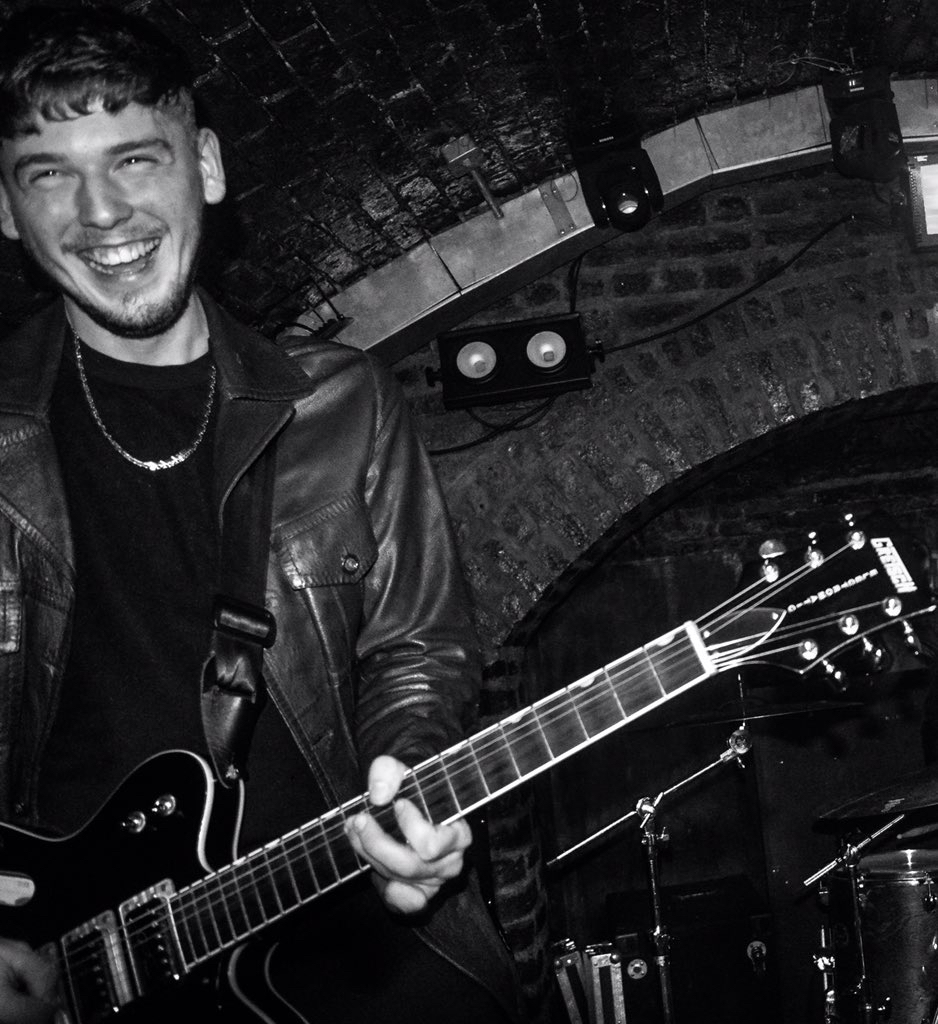
Skype interviews are a little daunting, two relative strangers on a video call isn’t without its challenges. Liam answered, guitar in hand, and I instantly knew that music has nothing to worry about. He spoke of the ease at which he is able to write new material in isolation, as well as keeping the band active through the likes of WhatsApp and FaceTime. It was refreshing to hear someone so upbeat.

IMG_2EE78103C688-1

However, what struck me about talking to Liam was his attitude to the bigger picture. Liam is incredibly in tune with the local Birmingham music scene and is acutely aware of the risks to the venues we know and love in the city. Yet he remains philosophical, he constantly returns to the idea that the future of music is of less value than the health of our wider community. Liam personally came up with an idea of creating a print using some of the band’s song lyrics that would be sold in limited numbers in aid of the NHS. At a tricky time for everyone, his idea raised £200 for the NHS inside 10 minutes. I feel like Liam underplayed this in our chat, but it really speaks volumes for him as a person and for The Clause as a band.

The live music industry is clearly under pressure during this time of crisis, but there is hope. I could’ve written about all sorts of positivity in this post, however it is probably better when it comes from within the bubble of grassroots music itself.

You can listen to the full chat with Liam at the following link: https://open.spotify.com/episode/1y7tPgSB4JEqc8z8i4DB05?si=iAm3X9p8RwaHUy7qfXHs3A

All pictures via Livv Galbraith. (www.instagram.com/oliviajean.photography/)

Policing 21 years on from the Macpherson Report

On 22nd April 1997 Stephen Lawrence was murdered by a group of white youths in an attack that was unprovoked and racist. The Metropolitan Police’s actions at the scene and in the later investigation were heavily criticised due to their incompetency and institutional racism. It was only in January 2012 that two of Stephen’s murderers, Gary Dobson and David Norris, were found guilty of his murder.

On 31st July 1997 the UK’s home secretary, Jack Straw, ordered Sir William Macpherson to carry out an inquiry into the investigation and wider problems that arose from the death of Stephen Lawrence. The Macpherson report was published on the 24th February 1999. Amongst its findings was one key statement, that the Metropolitan Police’s investigation had been “marred by a combination of professional incompetence, institutional racism and a failure of leadership by senior officers”.

The inquiry also found that this institutional racism was not a problem that was exclusive to the Metropolitan Police and instead it affected police services across the country. To begin to right the wrongs that were committed in the tragic case of Stephen Lawrence’s murder, the report outlined 70 recommendations for police forces across the UK. These recommendations covered themes like openness and accountability, a new definition of ‘racist incident’, the recruitment and retention of minority ethnic staff and many more.

Following the publishing of the Macpherson report on race and justice, a range of promises were made by police forces across the country. One such promise was police chiefs vowing to make their police forces look like the communities they served by having the same proportion of ethnic minorities as the populations they policed. They were given a decade to hit these targets and every single police force missed it. In England and Wales there is a race deficit in policing, as on 7% of officers are from ethnic minorities compared to 14% of the population. A study also found that black police officer numbers barely increased since the middle of the last decade, rising by 86 officers across the 44 forces of England and Wales between 2007 and 2018.

The amount of time it has taken to boost diversity in the police force is shocking, and although policing has faced difficulties with cuts to funding and numbers across the country, it is still an issue that must be addressed further. 

In February 2020, Juliana Christianson sat down with Chief Constable Andy Cooke QPM of Merseyside Police for an interview. They covered a range of topics from the decrease in police numbers, whether graduates make good police officers, and what measures Merseyside Police have been taking to promote diversity both within their ranks and in recruitment. Now 21 years on from the publishing of the Macpherson report, and 24 years on from the death of Stephen Lawrence, it is important to hear from the police what measures they are taking to fulfil the promises they made 21 years ago. Fulfilling these promises, as well as improving relationships between police forces and their communities, is the key to ensuring that the UK has police forces that work well for the people they are there to protect.

The full interview with Chief Constable Andy Cooke of Merseyside Police is available both on SoundCloud and Spotify.

Coronavirus Conspiracies

stay-home-save-lives-4983843_1280

The Coronavirus is a very harmful and contagious disease that’s causing a lot of stress and worry at the moment. However, there’s also a lot of confusion and myths about the virus too. So here, I am providing some light relief and debunking some myths and conspiracies about the virus.

karaoke_1First, I’d like to remind everyone that karaoke parties are not essential. Shocking I know! So please, do not go to your friend’s house for a karaoke party, and do not host a karaoke party and invite people who aren’t in your house. And for karaoke parties with members of your household…they’re allowed, but please remember we’re all stuck inside. I’m confident your neighbours don’t want to hear your attempts at reaching the high notes in Whitney Houston’s I will always love you. So keep the volume down!

I’m confident that everyone has heard about the rumours that 5G caused the coronavirus. However, there is 0 evidence to support this claim. What a surprise! In case you are unfamiliar with this rumour, many believe that the 5G wireless technology caused coronavirus because it weakens the immune system. Which isn’t true. This rumour has spread because of claims that Wuhan was the 1st city to receive 5G. Yet, Wuhan was one of a number of cities that received 5G and those cities haven’t experienced the same outbreak of coronavirus.                      Additionally, a new rumour has begun to spread that the British government set up the clap for our NHS as a weekly event so no one hears their 5G tests that makes a loud buzzing sound. Again, this is not true. Please continue clapping for the NHS.

downloadThere is absolutely no proof that eating garlic will prevent coronavirus, as nice as garlic bread is. Yet one woman believed this would protect her and she ate 1.5kg of raw garlic. Whilst there is no report that she has coronavirus, she did end up in the hospital with an inflamed throat. So please, abstain from eating raw garlic.

Tangled+750x500Personally, I don’t believe that the Disney film Tangled predicted coronavirus. However, I can’t deny that the signs are there. Rapunzel was locked away in a tower and wasn’t allowed to go outside. She was being kept from the kingdom called Corona. So maybe time travel does exist? But I very much doubt this is more than a strange coincidence.
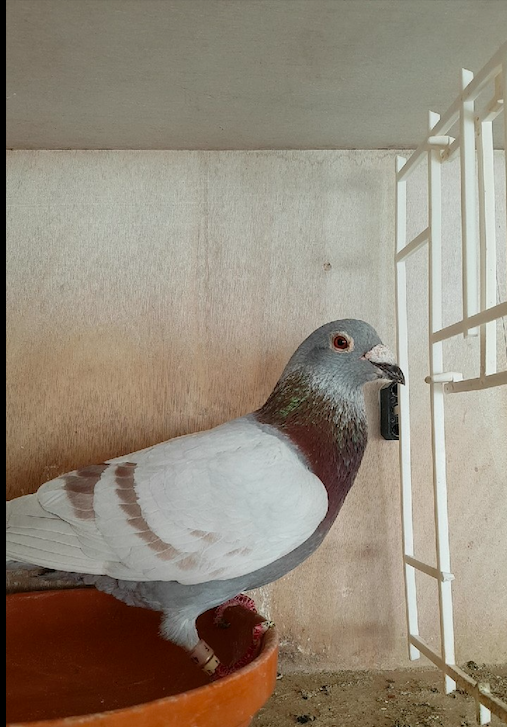
originalAnd finally, is there no coronavirus? Are we just being told to stay inside so the government can change the batteries in the birds? I’d have to say no. we cannot ignore the tragedy that coronavirus is and the lives it’s taking across the world. And obviously, the birds are solar-powered!
Please stay at home! Listen to all of our episodes here on SoundCloud to keep you company in this lonely time and look after yourselves! https://soundcloud.com/thepoliticshour2018

Written by Rachael Hughes


Does Jane Fonda care about the environment? Or is this a publicity stunt?

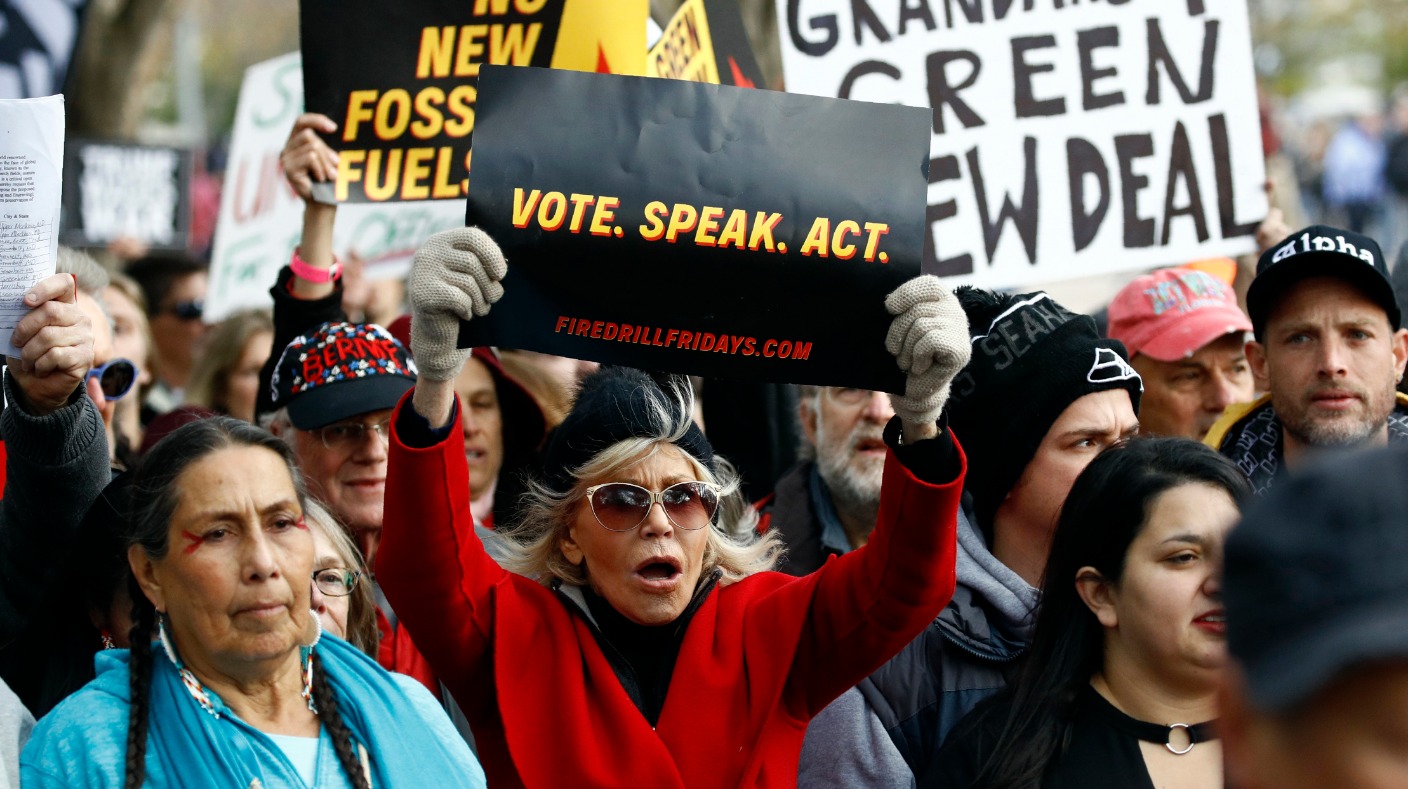
imgThis question follows the virtual climate protest with Fonda on Friday, April 3rd. Fonda has been attending weekly protests known as Fire Drill Fridays in Washington DC for a number of months now. Due to the coronavirus outbreak, the organisation has decided to move protests online to keep supporters safe.
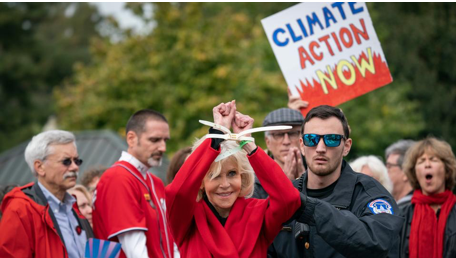
Jane Fonda is a well-known American model, actress, fitness instructor, and political activist. Within the last 12 months, Fonda has begun protesting on behalf of the climate alongside the Fire Drill Fridays organisation. Fire Drill Fridays are campaigning the U.S. government for 3 things:

To introduce a new green deal,

To halt all new coal, oil and gas investments and infrastructure and ban fossil fuel projects,

Phase-out existing fossil fuel projects and transition to a renewable energy economy.

Picture1Fire Drill Fridays have begun holding weekly protests that Jane Fonda has frequently attended. At these protests, Fonda is often arrested whilst smiling, which is where many have questioned her motives. Fonda is a wealthy and famous woman, who can be arrested and afford to pay bail. Many others would lose their job, housing or stability if they were to be arrested for protesting. Thus Fonda’s actions have been labelled as performative and cry’s for attention. A lot of this controversy arose in late October when Fonda accepted her Stanley Kubrick Britannia Award for Excellence in Film whilst being arrested.

However, Fonda has also been called a hero, legend and a feminist icon for bringing the Picture2media’s attention to the climate debate. Celebrities’ involvement in politics is often passive, meaningless or just to advance themselves. Yet, this can’t be said for Fonda who has been politically active all her life. Her mug shot from protesting against the Vietnam war is one of the most iconic celebrity mug shots. Fonda has been vilified by right-wing figureheads but has never reacted to criticism or feared her activism would harm her career.

Jane Fonda has used her position in society to enhance the attention given to social issues. Fire Drill Fridays wouldn’t be known about if it wasn’t for her. Her acts are performative and their purpose is to draw attention to herself as they also draw attention to the cause.

Screen shot from the virtual protestsSince the coronavirus outbreak, the climate debate has been quiet. This is understandable. However, Jane Fonda and Fire Drill Fridays hosted an online protest on Friday, April 3rd which resulted in technical difficulties due to the number of people who tried to join. Thus it’s clear that Jane Fonda has brought a lot of positive attention to the cause.

Many are still unimpressed at celebrity involvement in politics. But you can’t doubt the purity and good intentions of Jane Fonda’s involvement in climate protest.

I spoke about Fonda’s activism in our show in November. The segment starts at 7:15: https://soundcloud.com/thepoliticshour2018/international-politics-hour-show-5

More information about Fire Drill Fridays can be found at their website: https://firedrillfridays.com/

Written by Rachael Hughes

The BAFTAs and Oscars 2020: Diversity and Environmental Concerns, with Dr Niamh Thornton

by Toby Lawson

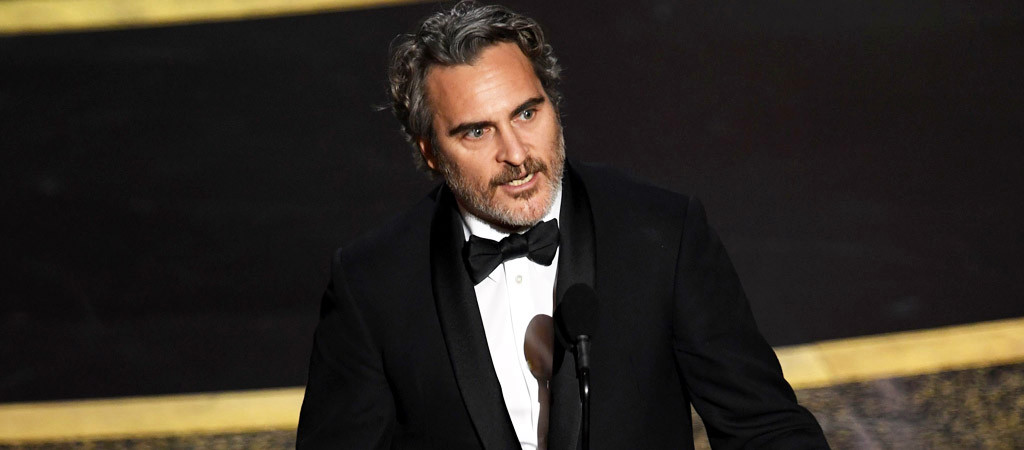
This year’s BAFTAs and Oscars, the two biggest film award ceremonies here in the UK and in America, were surrounded by discussions of diversity and environmental activism. The events were marred in controversy in respect to the lack of diversity their awards seemed to showcase, with many shocked that 2020 events seemed like a step in the wrong direction. At the BAFTAs not a single person of colour was nominated in any of the acting categories, with the Oscars only nominating one, Cynthia Eviro in her role in Harriet (2019). In respect to female diversity, there was not a single female director nominated at either event, with many feeling Greta Gerwig and her film Little Women (2019) was snubbed at the events. Indignation at these decisions were highlighted even in the events outfits, with Natalie Portman sporting a cape at the Oscars emblazoned with the names of overlooked female directors such as Gerwig. Ultimately, as host Graham Norton pointed out ironically, this became the year ‘white men broke through’, symbolised through the 11 nominations for the film Joker (2019), which Norton joked was the story where ‘a white man made himself whiter’. Joaquin Phoenix, star of Joker, was not happy to just accept this success, bringing attention in his BAFTAs victory speech to point out that these events ‘send a very clear message to people that you’re not welcome here’ when referring to the lack of diversity (https://www.theguardian.com/film/2020/feb/02/joaquin-phoenixs-attack-on-baftas-for-systemic-racism-meets-industry-wide-praise).

To try understand the issues the lack of diversity entails, I spoke to Dr Niamh Thornton, a Reader in Latin American studies in the University of Liverpool’s Film Studies department. When asking her about the importance of diversity, she said that despite these film ceremonies at first just representing a trade show, their popularity has meant it become more about a representation of ‘who do we privilege and what do we value, and also who do we value and whose stories get valued’ in the film industry. She linked this then to visual representation, the idea that ‘If you can’t see it you can’t be it’, with awards piled on films centred around white, male stories sending a clear message to those different that their story is not as valuable and that you are not part of the ‘cultured conversation’ in film. Dr Thornton argued this culture needed to adapt beyond solely films made by white people, featuring white people from ‘the west’ and instead to create and then include stories in this culture that feature more women as well as those from areas that are usually overlooked, such as Africa, crediting the work of filmmakers such as Geena Davis and Ava DuVernay in pushing these ideas. The awards however did not just send out negative messages, with the surprise win of Parasite (2019) as first non-English best picture and its director Bong Joon-Ho as winner of best director at the Oscars represented a shift at the awards. Dr Thornton highlighted how Parasite’s success showcased how the Oscars ‘have really changed the make-up’ of the panels who decide winners, incorporating more globalist inclusivity to their decision making.

As well as diversity issues, the events saw unprecedented levels of focus on environmental issues, especially climate change and single use plastics. The events promised this year to reduce waste and energy use as much as possible, with the BAFTAs taking measures such as banning single use plastics, using a recycled red carpet, introducing vegan meals, replacing the goodie bag with a ‘gifting wallet’ made of recycled plastic and encouraging guests to reuse or buy sustainable outfits. Best Actor winner at both events Joaquin Phoenix also brought attention to the importance of his diet, Veganism. An obscure diet as of several years ago, its has surged in popularity in recent years, especially in respect to the prevalence of climate change. On what was probably the high-profile endorsement of Veganism, Phoenix dedicated his Oscars acceptance speech to it, lamenting how humans ‘go into the natural world and we plunder it for its resources. We feel entitled to artificially inseminate a cow and steal her baby, even though her cries of anguish are unmistakeable’ (https://www.theguardian.com/film/2020/feb/10/joaquin-phoenixs-oscars-speech-in-full).

When talking to Dr Thornton about this new emphasis on environmentalism, I asked how the film industry can endorse such claims whilst also being a huge contributor to carbon emissions. The film industry requires huge amounts of energy through extensive air travel, in filming, lighting, special effects and the vast crews they require to be produced. The film ceremonies themselves were places Dr Thornton thought were ‘a really good place to have the conversation and provoke the conversation’ around these issues in bringing wider prevalence to these ideas, not in necessarily changing anyone’s minds but making them think about what Veganism and Climate Change. In terms of their resource use, Dr Thornton thought the Dogme-95 rules of film making, in advocating for less special effects and more natural lighting although not intended to combat energy use, might become useful as a precedent in the future for films having an energy ‘ten commandments’ when filming to in order to reduce their carbon footprint in respect to climate change. When financially backed by governments or national organisations in the UK, films are already subject certain guidelines concerning their carbon footprint and Dr Thornton would not be surprised if in the future, with the increasing seriousness of climate change these will have to be thought about ‘differently or more thoroughly’ than they are currently.

This year’s film events certainly left a lot to discuss and thank you to Dr Niamh Thornton for taking the time out to talk to me about these issues. This was only a brief overview of our discussion and our full interview can be found here https://soundcloud.com/thepoliticshour2018/week-3-uk-show. For further discussion around these events Dr Thornton has written an article focusing on how Jennifer Lopez was overlooked at this year’s events and the wider significance this has concerning diversity https://reframe.sussex.ac.uk/mediatico/2020/02/03/so-why-hasnt-j-lo-been-nominated-for-any-of-the-big-film-industry-awards/.

Pigeon Racing and its growth in China

Pigeon Racing and its growth in China

What is Pigeon Racing?

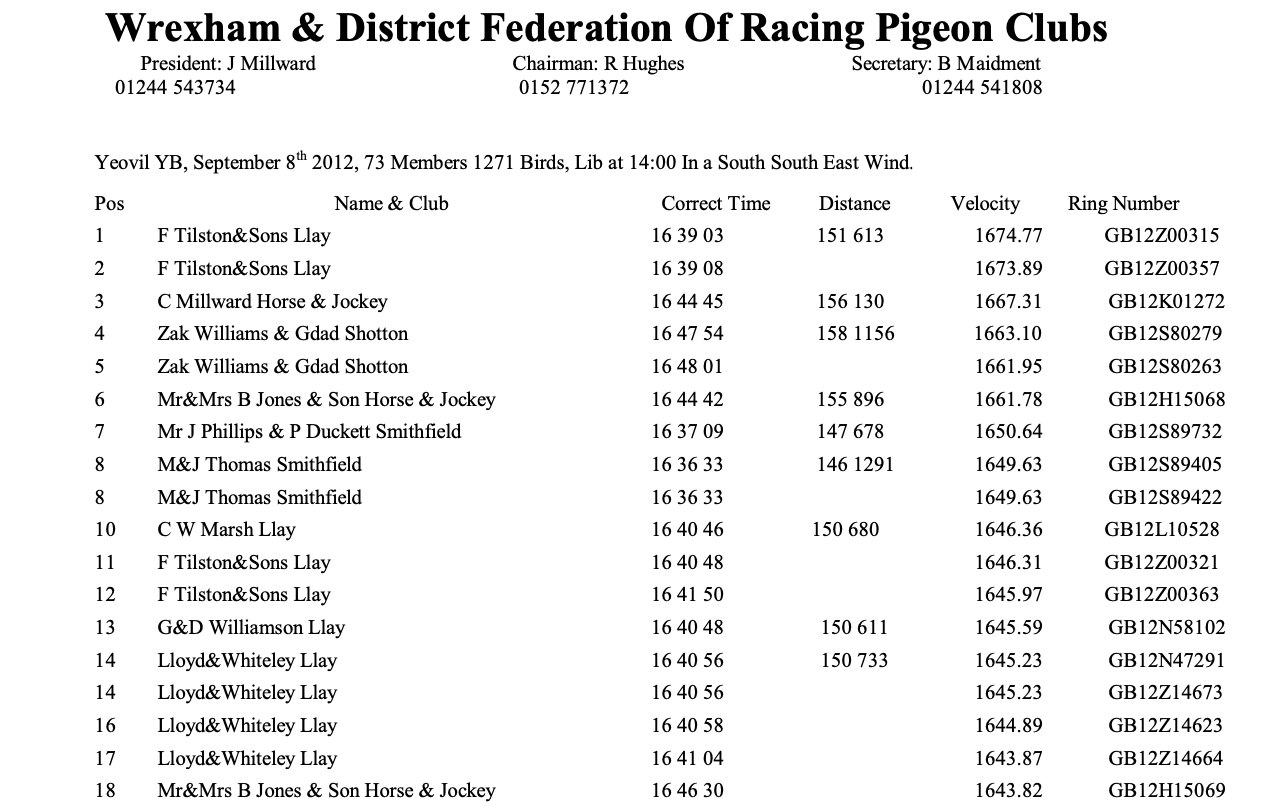
 Pigeon Racing is typically conducted from April to September. In the UK the old birds (anything from 1 years and older) race from April to July, and the young birds race from July to September. The pigeons typically fly from distances of 70 miles up to 700 miles. The pigeons are marked, typically on a Friday (sometimes a Wednesday or Thursday for longer races overseas) and are then sent off on a lorry to the race point. The birds are released normally the next morning, or a couple of days after if the race is from France, Belgium or Spain, weather permitting. As some flyers live closer to the race point than others, all flyers are given distances (measured in miles and yards). This allows for the velocity of a bird to be calculated, which is usually distance divided by time. Once the birds arrive home, they are clocked into the flyers pigeon loft, usually by a pad, where the ring on the pigeons leg sends a signal to the pigeon clock of the birds ID number. The clock recognises the bird and the race it was entered into when they were marked before being put on to the lorry and transported to the race point. In countries such as Belgium and China, the race results can be calculated as quickly as the birds enter the loft of their respective owners. Big races in the UK are also going this way, with the National races enforcing a rule that the flyer must verify the time of arrival of their first bird home within an hour of clocking, which is then translated into a leader board for all to see online as the race is unfolding.

 So what is the demographic of Pigeon Racing?

Pigeon Racing is a sport that is most associated with older men, who are retired. However this is not exactly the case, and is actually a quite damaging stereotype for the sport – particularly because of the issue of recruiting younger members into the sport. There is no doubt though that a majority of pigeon fanciers in Britain and Belgium have been working class men, however. But this does not mean that pigeon racing is solely an older, male sport. In recent times the sport has lost a massive number of fanciers since 1990, with figures going from 60,000 to 21,000 in 2019.

Story of China: a sport on the up.

The story in China is different, however. The sport is increasing in popularity year on year, and the prize pots are increasing too. For example, the Iron Eagle race prize pot, which is a 500km race at the end of the season, is currently 49-million-pound sterling. This is leading to an inflation in the price of birds in countries such as Belgium and the UK who have some of the most prized birds in the world. This is exemplified in the recent world-record price of 1.25 million euro for the bird called “Armando”. “Armando” is a champion bird in Belgium and considered one of the greatest long-distance pigeons of all time. Long distance is defined as longer races, over 300km most of the time. Mr Xing, the new owner of “Armando”, visited PIPA, also known as Pigeon Paradise, not so long ago. PIPA is the organisation which sells prized birds. They represent a professionalisation of the sport, where DNA tests of the birds are taken to ensure that they are the correct offspring off the champions.

Screenshot 2020-03-06 at 22.59.59
A typical race result sheet, with the time of arrival, distance, velocity, and ID number of each bird. 

Armando
Armando, who was recently sold for 1.2 million euro to Chinese owner Mr Xing.

Screenshot 2020-03-06 at 23.10.04
A typical pigeon clock which records the arrival of the pigeons.

The issue that this growth in China flags up is the embourgeoisement of pigeon racing in recent years. Birds are now being bought by businessmen as prized assets, not just to breed and race off, but as symbolisms of status and wealth. This has led to fears that the working-class origins of the sport are slowly being hollowed out, with more and more of the top fanciers being a closed off circle of elite businessmen. Whether this carries on is to be seen, but the increase in information technology means that fanciers all around the world can find out which birds are winning races all around the world, pretty much instantly after that race has taken place and the results have been published. Many years ago, this wasn’t the case, mainly as results were slow to be calculated due to having to be processed via hand. But now, with the rise of ETS (Electronic Timing System), the results of races are posted online as soon as the birds enter their respective lofts and are then published online. This has revolutionized the sport but also flags up the wider issue of the digital divide in society. Them who have access to the internet have a massive advantage in being able to buy the best birds all around the world. Again whether this leads to a further diminishment of the sport is up for debate.

Charlie Millward (6/3/20).

Screenshot 2020-03-06 at 23.11.39
A picture of a racing pigeon, taken five minutes after arrival after being liberated with 1,500 other pigeons in Ancenis, France. The bird made the 412 mile trip home to Buckley, Norh Wales, in 11 hours and 20 minutes.

Veganism: Is it worth it?

According to studies from the Martin School of Research (University of Oxford), a global switch to diets that rely less on meat and more on fruit and vegetables could save up to 8 million lives by 2050. This switch could also reduce greenhouse gas emissions by two thirds, and lead to healthcare-related savings and avoided climate damages of $1.5 trillion (US). (https://www.oxfordmartin.ox.ac.uk/news/201603-plant-based-diets/)

But surely if we all turned to a vegetarian/vegan diet there would be serious economic and political trade-offs? If we all turned vegan tomorrow, how would our rural economy, which relies so heavily on meat production, cope with the loss of demand? How high would unemployment rise and who would be affected?

In the wake of Brexit, surely the UK economy needs to support our industries rather than force them into a decline in the name of the benefits of veganism. Is it not those who are worst off in our society who are unable to join this vegan revolution? All these questions and worries were put to The Vegan Society Campaigns and Policy Officer, Timothy Thorpe, who I quizzed and questioned on the real effects of veganism.the vegan society

The Vegan Society (https://www.vegansociety.com/) is a registered charity founded in 1944, making it the oldest of its kind on the planet. My conversation with Tim involved discussions around the bigger picture of veganism, promotion of the lifestyle in the UK, and questions about what a vegan economy would look like. We also discussed the possibility of agricultural transition to a plant-based farming economy and how the potential negative externalities could be minimised.

Ultimately, our interview was a search to answer the question:

Is it worth switching to veganism in the UK?

Listen to our conversation and see what you think at: https://soundcloud.com/thepoliticshour2018